
If your design workload is steady, predictable, and tied to one brand, an in-house team usually wins on speed and cost control. If your needs swing between video, branding, decks, and campaigns — or you simply don’t have enough volume to justify a full-time salary — a graphic design agency gives you more skill and less risk. There’s no universally “better” option here; there’s only the option that matches how much design work you actually generate every month.
This guide breaks down the real cost difference, the hidden trade-offs nobody puts in the brochure, and a simple framework to decide for your business — instead of just listing generic pros and cons.
What’s the Real Difference Between In-House Design and an Agency?
An in-house designer is your employee. They sit inside your company, know your product line by heart, and are available the moment you need a banner resized or a last-minute deck fixed. A graphic design agency is an external team you hire on a project or retainer basis — you get access to a full bench of specialists (branding, packaging, motion, web) without adding anyone to your payroll.
The distinction that actually matters for decision-making isn’t “who’s better at design.” It’s who owns the risk of underused or overused capacity. With an in-house hire, you carry that risk — you pay the same salary whether they have five projects or none. With an agency, the agency absorbs it — you pay for what you use, and they reallocate their bench across clients.
How Much Does Each Option Actually Cost?
This is where most comparisons get vague. Here’s what the numbers actually look like.
In-house designer (India): According to Indeed’s India salary data, the average graphic designer earns roughly ₹18,888 per month in India, based on over 2,000 reported salaries, with the highest-paying cities being New Delhi and Hyderabad, at roughly ₹46,000–47,000 per month. That’s the salary line alone — before you add PF, ESI, paid leave, a laptop, design software licenses, health insurance, and the desk space they occupy. A realistic fully-loaded cost for one mid-level in-house designer in a Delhi NCR company usually lands 25–40% above the quoted salary once these are included.
Graphic design agency: You pay per project, per deliverable, or a monthly retainer that’s scoped to your actual volume. A logo and brand identity package might be a one-time cost; ongoing social creatives or a pitch deck pipeline are usually retainer-based. The agency spreads its designers, art directors, and strategists across multiple clients, so you’re effectively renting a fraction of a much larger, more experienced team instead of buying one person outright.
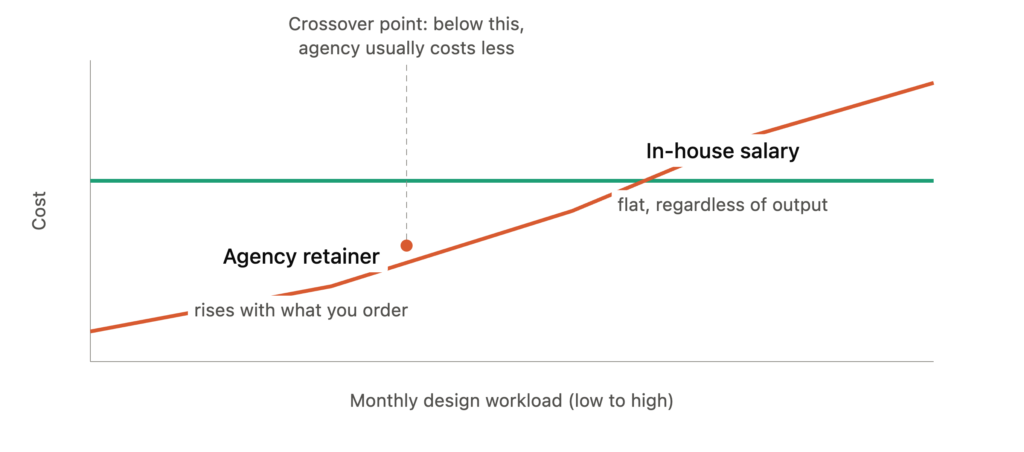
The financial trade-off is simple: in-house cost is fixed regardless of output; agency cost scales with what you order. If your design requests are lumpy — heavy in launch months, quiet the rest of the quarter — you’re paying full salary for idle time with an in-house hire. If your requests are constant and high-volume, month after month, the math can flip, and a salaried employee becomes cheaper than an agency retainer over a year.
| Factor | In-House Design Team | Graphic Design Agency |
|---|---|---|
| Cost structure | Fixed monthly salary + benefits, regardless of workload | Variable — pay per project or retainer, scoped to actual need |
| Skill range | Limited to what that person (or small team) knows | Full bench: branding, packaging, motion, web, print, strategy |
| Turnaround for urgent asks | Immediate — they’re in the building | Depends on agency bandwidth and SLA terms |
| Brand knowledge depth | Deep — lives and breathes one brand daily | Builds over time, formalized through brand guidelines and briefs |
| Scalability | Requires hiring more people to scale up | Scales up or down within the existing relationship |
| Onboarding time | Weeks to months (hiring, training, tool setup) | Days — agency already has process and tools in place |
| Risk during slow periods | You still pay full salary | You simply order less |
| Creative range over time | Can plateau — one person’s taste and references | Naturally refreshed by working across multiple brands/industries |
When an In-House Design Team Makes More Sense
An in-house hire earns its cost back when design isn’t occasional — it’s the daily engine of the business. A few concrete signals:
- You generate design requests every single working day. Think e-commerce brands running constant product shoots and listing graphics, or a media company producing daily social content. At that volume, a salaried designer working 8 hours a day is simply cheaper per output than paying agency rates for the same volume.
- Your product changes fast and needs someone embedded in it. SaaS companies shipping new features weekly often need a designer who sits in the same sprint planning meetings as engineering — not someone briefed over email once a week.
- Same-day turnaround is non-negotiable. If a sales team needs a one-pager reworked in an hour before a client call, an in-house designer who already knows the brand system will beat an external team’s response time almost every time.
- You have the management bandwidth to run a design function. An in-house hire needs a manager, feedback loops, career growth, and tools — someone has to own that, or the designer stagnates and eventually leaves.
The honest trade-off: even a strong in-house designer is one person’s skillset and one person’s bandwidth. If they’re out sick during a launch week, there’s no backup bench to lean on unless you’ve built a full team.
When a Graphic Design Agency Makes More Sense
An agency tends to be the stronger call when your needs are broad, occasional, or high-stakes enough that you can’t afford a learning curve. Specifically:
- Your design needs are varied, not repetitive. One month you need a pitch deck for investors, the next a product video, then a full rebrand. No single in-house hire realistically covers video production, brand identity, and presentation design at a senior level — an agency team already has specialists for each.
- Your volume doesn’t justify a full-time salary. If you need meaningful design output twice a month, not every day, you’d be paying a full-time wage for part-time work. A retainer or per-project agency engagement lets you pay only for what you actually order.
- You need outside perspective, not just execution. Agencies work across industries and bring pattern-matching from dozens of other brands — useful when you’re rebranding or entering a new market and need fresh thinking, not just someone executing your existing visual language.
- The project is high-stakes and time-bound. An investor pitch deck, a product launch video, or a rebrand has a hard deadline and no room for a first-time hire’s learning curve. Agencies that specialize in exactly that deliverable typically move faster because the process is already built and repeatable.
Clutch’s 2026 research on how businesses use design supports this pattern at scale: 90% of businesses use graphic designers in some capacity, and even with AI tools now widespread, 47% of businesses increased their design budgets over the past year, with 53% expecting to increase investment further over the next 12 months. Design demand isn’t shrinking — if anything, businesses are leaning on external design expertise more, not less, as their needs diversify beyond what one internal hire can cover.
Common Mistakes Businesses Make in This Decision
Comparing salary to agency invoice without adjusting for output. A ₹19,000/month designer looks cheap next to a ₹60,000 agency retainer — until you count that the retainer might deliver 15 polished assets a month across three design disciplines, while one in-house junior might realistically deliver a fraction of that at a similar skill level.
Hiring in-house too early. Many small businesses hire a “graphic designer” as their second or third employee because it feels like ownership, then discover the workload doesn’t fill a 40-hour week — and the designer either gets bored or starts doing tasks outside their skill set.
Assuming an agency means losing control. A well-briefed agency relationship, with clear brand guidelines and a defined point of contact, usually produces more consistent output than an internal designer working without any documented brand system — the myth that agencies are “less aligned” is mostly a symptom of poor briefing, not a structural weakness of the agency model.
Not factoring in management overhead. An in-house hire isn’t “free” once salary is paid — someone has to brief them, review work, and manage their growth. That’s real time cost that rarely makes it into the comparison spreadsheet.
Can You Get It by Yourself? (DIY Design Tools)
Before comparing in-house vs. agency, it’s worth addressing a third option many small businesses try first: doing it themselves using tools like Canva, Figma community templates, or AI image generators. This works for low-stakes, low-frequency needs — a quick Instagram story, an internal slide, a placeholder banner.
It stops working the moment design touches anything customer-facing at scale: a pitch deck an investor will judge your company by, a brand identity meant to hold up across five years and a hundred touchpoints, or a product video competing for attention in a crowded feed. At that point, the gap isn’t tool access — Canva has plenty of features — it’s the strategic judgment behind how those tools get used. That judgment is exactly what both in-house designers and agencies are paid for, and it’s the reason the DIY route usually becomes a stepping stone rather than a permanent solution once a business starts scaling its visual presence.
A Simple Way to Decide
Ask three questions in order:
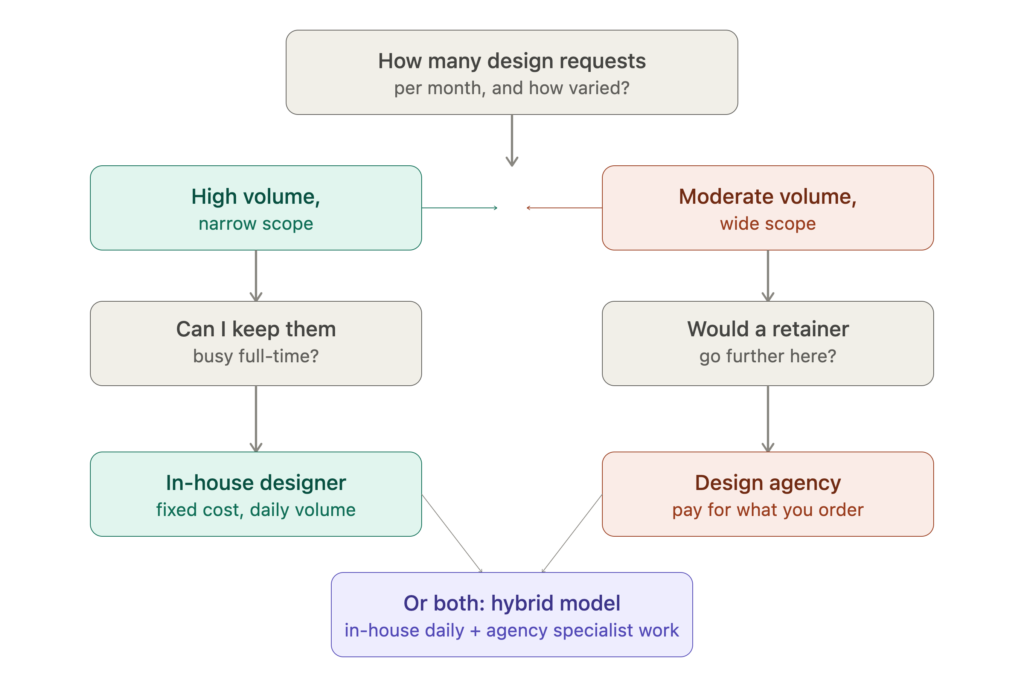
- How many design requests do I generate in a typical month, and how varied are they? High volume + narrow scope → lean in-house. Moderate volume + wide scope (branding, video, decks, packaging) → lean agency.
- Can I justify and manage a full-time salary today, or would that budget go further as a flexible retainer? If the honest answer is “we’d struggle to keep them busy,” that’s your answer.
- Is there a hybrid path? Many growing companies run both — a lean in-house designer for daily execution and quick turnarounds, backed by an agency for branding, pitch decks, video, and anything that needs specialist depth. This is increasingly the default for companies past the very early stage, not an edge case.
There’s no wrong answer here as long as it’s matched to your actual workload — the mistake is picking a model based on what feels more “legitimate” rather than what your design volume genuinely supports.
Growthkul works with businesses across Delhi NCR on exactly this range of specialist design work — from brand identity and presentation design to video production — for companies that need agency-level depth without building an in-house team from scratch.
