
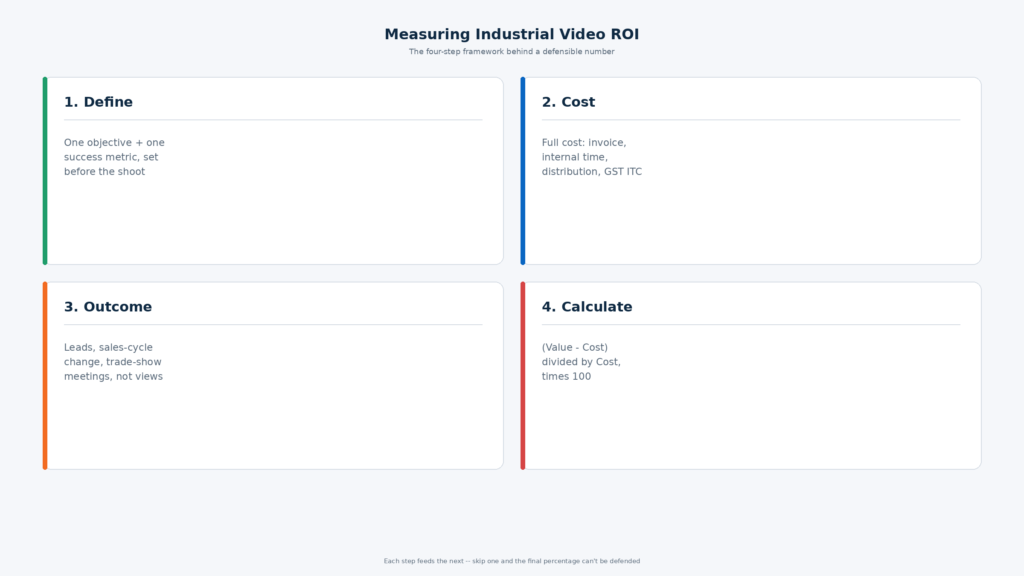
Industrial video ROI is calculated by comparing the measurable business outcomes a video generates — qualified leads, shortened sales cycles, trade-show conversions, reduced training incidents — against its full production and distribution cost, expressed as a percentage: (Value Generated − Total Cost) ÷ Total Cost × 100. The hard part isn’t the formula. It’s that most Indian manufacturers stop at view counts, which don’t actually answer whether the ₹1.5 lakh factory tour film paid for itself.
That gap matters more in industrial marketing than almost anywhere else. A single video can influence a sales cycle that runs close to a year, gets watched by three different stakeholders at the buyer’s company, and never gets clicked on, shared, or liked in any way a dashboard would notice. This guide breaks down what industrial video ROI actually means, what these videos really cost in India, how to calculate returns properly, and what to do when the numbers don’t look good yet.
What “ROI” Actually Means for an Industrial Video
Ask most plant managers what a factory video achieved and they’ll quote a view count. That number is almost meaningless on its own — a video watched 50,000 times by the wrong audience has delivered less business value than one watched 200 times by procurement heads at the five companies you’re trying to close.
Industrial video ROI has to be tied to a specific business objective defined before the camera rolls, not reverse-engineered from whatever metric looks best afterward. A factory tour film aimed at international buyers should be judged on export inquiries and trade-show follow-up meetings. A safety training video should be judged on incident reduction, not watch time. A recruitment film for a new plant should be judged on qualified applications, not likes on LinkedIn.
The practical starting discipline is writing the objective and the one metric that proves it down on paper before production begins, and refusing to let the final report quietly substitute a vanity metric when the real one underperforms.
What an Industrial or Factory Video Actually Costs in India
You can’t calculate a return without an honest denominator, and most ROI conversations collapse here because the “cost” used is just the production invoice, ignoring everything else that went into getting the video made and seen.
Indian industrial video pricing varies sharply by scope. A basic one-day factory tour shoot with a three-minute edit typically runs ₹65,000 to ₹1,20,000, according to pricing benchmarks published by IRPR Agency’s Pune industrial videography guide. A more involved industrial documentary — multi-day shoot, drone footage, interviews, motion graphics — starts around ₹5 lakh for premium quality, per the same agency’s Mumbai pricing page. Factory safety and compliance training videos sit in a wide band, roughly ₹40,000 to ₹2,00,000, depending on duration, whether it’s animated or live-action, and how many languages the voiceover needs to cover — a real consideration for plants with Hindi, Marathi, Tamil, or Telugu-speaking shop floor staff. These are single-agency published rates rather than an independent market survey, so treat them as a directional benchmark to sanity-check quotes against, not a fixed price list.
The invoice is only part of the real cost. A complete denominator should include internal time (plant managers and engineers pulled away from their jobs for shoot days and script reviews), paid distribution if the video runs as a LinkedIn or YouTube ad, translation or subtitling for export markets, and any trade-show screen or booth integration cost. Most teams undercount total video investment by a wide margin because they only look at the production line item.
An India-specific line most ROI calculations miss entirely: advertising and marketing services, including video production, are generally eligible for Goods and Services Tax input tax credit for a GST-registered business, since they qualify as services used in the furtherance of business, per guidance published by ClearTax and TaxAJ. At the standard 18% GST rate applied to most production and digital marketing services, a GST-registered company can typically offset that portion against its output tax liability — meaningfully reducing the real net cost of the video versus the number on the invoice. This doesn’t apply to every scenario (promotional giveaways and certain FOC distributions have been denied ITC in specific Authority for Advance Ruling cases), so confirm applicability with your accountant before assuming it into a budget.
Horizontal bar chart comparing India industrial video cost benchmarks: factory tour, safety training, industrial documentary Indicative India pricing bands by industrial video type — confirm against current agency quotes
The Outcomes That Actually Count for Industrial Buyers
Industrial and manufacturing sales cycles behave very differently from consumer or even typical B2B SaaS sales, which is exactly why generic video ROI advice falls short for factory and plant content.
Manufacturing content marketing research from the Content Marketing Institute’s 2025 benchmarks found video is the single most effective content format for manufacturing marketers, cited by 74% of respondents, ahead of case studies at 45% and white papers at 43%. Buyer-behaviour research from Marketing LTB’s 2026 manufacturing marketing statistics found 71% of manufacturing buyers watch video content before requesting a quote — meaning the video is often doing its job well before your sales team ever gets a call. Separately, ThomasNet’s industrial buyer research puts the share of the purchase journey completed before a buyer engages sales at around 70%, a figure echoed across multiple industrial marketing studies.
The sales-cycle impact is where industrial video earns its budget most visibly. Compiled B2B video statistics from RevenueMemo’s 2026 analysis found that B2B video content shortens the sales cycle by an average of 23%, and that B2B companies using video marketing see 54% higher lead conversion rates. A more aggressive, single-source figure from Skyrex Productions, cited in Webtonic’s 2026 manufacturing video marketing statistics, claims explainer videos can cut the manufacturing sales cycle by as much as 52% — a notably larger number from one vendor’s own data, worth treating as an upper-bound claim rather than a typical outcome. Given that the average manufacturing purchase cycle runs around 379 days according to Dentsu’s 2024 research, even a modest reduction translates into real cash-flow value, since closing deals faster compounds across every quarter.
For export-facing manufacturers specifically, the relevant outcomes shift again: trade-show booth engagement, international buyer meeting requests after a video is shared pre-event, and inclusion in RFP shortlists where a facility video substitutes for an in-person plant visit that a prospective buyer can’t easily make.
There’s a structural reason industrial video measurement is harder than consumer or SaaS video measurement, and it’s worth naming plainly: an industrial purchase decision rarely has a single viewer. A plant video sent to one procurement contact typically gets forwarded internally to a quality assurance lead, a plant engineer evaluating technical fit, and a finance stakeholder weighing total cost of ownership — three or four separate views on three or four separate devices, none of which your analytics dashboard will ever connect into a single buyer journey. Average industrial B2B sales cycles run close to nine months according to aggregated industrial marketing research, and with 89% of industrial buyers researching online before ever contacting a salesperson, the video is frequently doing silent persuasion work across a buying committee weeks or months before any CRM record shows activity. This is precisely why a single-touch, last-click attribution model consistently undercounts industrial video’s real contribution — the conversation in the next section on applying the ROI formula builds the fix for that into the measurement approach directly, rather than treating it as an unsolvable gap.
The ROI Formula, Applied Properly to Industrial Video
The underlying formula is simple: ROI = (Value Generated − Total Cost of Video) ÷ Total Cost of Video × 100. The complexity in industrial video isn’t the arithmetic — it’s correctly attributing value to a video that influenced a sale nine months before it closed.
A workable attribution sequence for industrial video looks like this:
- Set a baseline before launch. Record current quote-request volume, trade-show meeting-request rate, or whatever your chosen metric is, for the weeks immediately before the video goes live.
- Track where the metric moves after launch, holding other marketing activity as steady as possible so the video’s effect isn’t drowned out by an unrelated campaign running at the same time.
- Attribute partial credit when multiple touchpoints are involved. If a buyer watched the factory tour video, then attended a trade show, then requested a quote, a reasonable approach assigns meaningful but partial credit to the video rather than 100% to the final touchpoint — most CRM systems can be configured for multi-touch attribution rather than last-click-only.
- Convert the outcome into value. A qualified lead is worth your average deal size multiplied by your lead-to-close rate; a trade-show meeting booked off the back of a pre-show video send is worth the same, adjusted for how many such meetings historically convert.
- Run the ROI formula against the full cost figure, not just the production invoice.
Flow diagram of the five-step industrial video ROI measurement process from baseline to calculation The measurement sequence that turns a video into a defensible ROI number.

Diagnosis Table: Which Metric Actually Proves Your Video Worked
Different industrial video types exist to do different jobs, and checking the wrong metric is the single most common reason a genuinely effective video gets reported as a failure.
| Video purpose | Metric that actually proves it worked | Vanity metric to ignore |
|---|---|---|
| Factory tour for export buyers | Export inquiries, RFP shortlist inclusion | Total YouTube views |
| Website explainer / homepage video | Quote requests, time-on-page before form fill | Autoplay view count |
| Trade-show pre-show send | Booth meeting requests booked in advance | Email open rate alone |
| Safety / compliance training | Incident rate change, audit pass rate | Internal “completion” clicks |
| Recruitment film for new plant | Qualified applications received | LinkedIn reactions |
| Investor / stakeholder facility film | Follow-up meeting requests, capital commitment conversations | Share count |
| Case study / client testimonial | Sales-cycle length for prospects who viewed it vs those who didn’t | Comments |
A Worked Example: ROI on a Factory Tour Video for a Pune Auto-Components Exporter
The following is a hypothetical, illustrative scenario built to show the calculation in practice — not a real client case study.
A mid-sized Pune-based auto-components manufacturer commissions a four-minute factory tour video aimed at European and Southeast Asian buyers evaluating new suppliers. Total cost, including a two-day shoot, drone footage, English and German voiceover, and three months of LinkedIn distribution, comes to ₹4.8 lakh.
Over the following two quarters, the company tracks the video against its baseline: export inquiries citing the video specifically (tracked via a dedicated landing-page link used only in video descriptions and trade-show follow-up emails) rise from a baseline of roughly 2 per month to 7 per month. Of those additional inquiries, the sales team’s historical conversion data suggests roughly 1 in 6 becomes a qualified opportunity, and roughly 1 in 3 qualified opportunities historically closes, at an average first-year order value of ₹18 lakh for a new export account.
Over six months, that’s 30 additional video-attributed inquiries, roughly 5 qualified opportunities, and — applying the historical close rate conservatively — slightly under 2 new accounts reasonably attributable to the video’s influence, worth approximately ₹32 lakh in first-year order value. Even assigning the video only half credit, given other marketing activity running concurrently, that’s roughly ₹16 lakh in attributable value against a ₹4.8 lakh cost: an ROI of about 233% using the standard formula. The point of walking through the math isn’t the specific number — it’s that the company can defend it in a budget review, because every input traces back to a tracked metric rather than a guess.
Funnel chart showing attrition from video views through to qualified leads and closed deals Where the numbers actually come from in a defensible ROI calculation.

Myth: “More Views Means Better ROI”
This is the single most persistent misunderstanding in industrial video measurement, and it skews budget decisions toward the wrong videos.
View count measures reach, not value, and reach without relevance is worthless in a market as narrow as industrial B2B, where the entire addressable buyer universe for a specialty component might be a few hundred companies worldwide. A product demonstration video that reaches 500 qualified procurement engineers has done its job completely even with a view count a consumer brand would consider a rounding error. Conflating views with ROI pushes marketing teams toward broad, generic content optimised for algorithmic reach instead of narrow, technically specific content that actually moves a plant manager or purchasing head toward a decision — exactly the kind of content CMI’s 2025 manufacturing benchmarks found performs best for this sector. The fix isn’t to ignore views entirely; it’s to always pair them with a second, buyer-quality metric — job title data on who’s watching, where available, or at minimum which pages and campaigns the views came from — before drawing any conclusion about effectiveness.
When to Measure: A Cadence, Not a One-Time Report
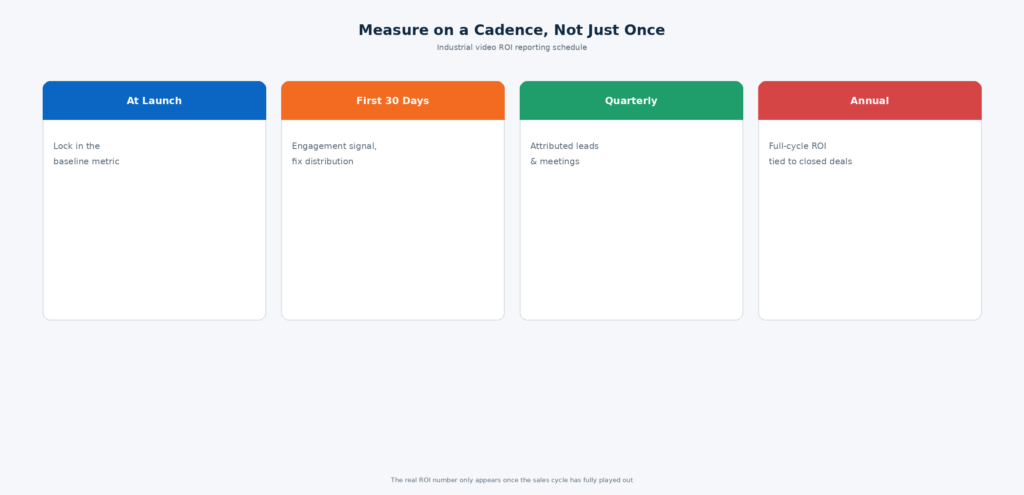
Industrial video ROI isn’t a single number you calculate once after launch and file away. The useful data changes shape over the video’s life.
| Cadence | What to check | Why |
|---|---|---|
| At launch | Baseline metrics locked in before the video goes live | Without a baseline, every later number is unverifiable |
| Every video, first 30 days | Early engagement signal: watch-through rate, click-to-landing-page rate | Flags a weak video or wrong distribution before budget is wasted on amplification |
| Quarterly | Attributed leads, trade-show meetings, inquiry volume vs baseline | Matches the pace most industrial sales cycles actually move at |
| Annual | Full-cycle ROI including closed deals, since manufacturing sales cycles can run close to a year | This is the only point at which the “real” ROI number — tied to closed revenue — becomes available |
Four-column card showing the at-launch, 30-day, quarterly and annual measurement cadence for industrial video Measure early for course-correction signals, measure annually for the real number
If Your Industrial Video Isn’t Showing ROI: The Recovery Plan
A video that looks like it’s underperforming at the 30-day mark isn’t necessarily a failed investment — industrial sales cycles are long enough that premature judgment is one of the most common and costly measurement mistakes.
If engagement is weak in the first 30 days: Check distribution before blaming the content. A technically excellent factory tour video sent only to a general email list, instead of segmented to the specific buyer personas it was made for, will underperform regardless of production quality. Re-target distribution to the right job titles and accounts before writing the video off.
If views are healthy but inquiries aren’t moving: The video may be reaching the right audience but failing to prompt action — check whether there’s a clear, low-friction next step (a specific landing page, a direct quote-request link) attached to it, rather than a generic “contact us.”
If the sales team says they’re not seeing the effect: Confirm the video is actually being used in the sales process — plenty of well-made industrial videos sit unused in a marketing folder because nobody briefed the sales team on how to send it at the right stage of a conversation.
If six months have passed with genuinely no movement on the target metric: This is the point to reassess the objective itself, not just the distribution — it’s possible the video solved a problem buyers don’t actually have at the stage it targets, which is a positioning issue a re-edit alone won’t fix.
What’s Changed in How Indian Manufacturers Measure Video ROI Recently
A few shifts are worth noting for anyone benchmarking against older playbooks. Wyzowl’s 2026 data cited in Webtonic’s manufacturing statistics roundup puts video adoption among businesses generally at 91%, meaning the competitive question for most Indian manufacturers is no longer whether to produce video but whether the one they’re producing is measured properly. GST input tax credit treatment of marketing and advertising services, while not new, remains underused in budget conversations — many finance teams still model video costs pre-credit rather than net of the available offset, overstating the real investment. And multi-touch attribution tooling that used to be enterprise-only is now commonly available inside mid-market CRM platforms, which removes the old excuse that industrial sales cycles were simply too long and multi-stakeholder to track video influence with any precision.
One-Page ROI Measurement Checklist
| Step | Done? |
|---|---|
| Objective and single success metric written down before production starts | ☐ |
| Baseline for that metric recorded before launch | ☐ |
| Full cost tracked, including internal time, distribution spend, and translation — not just the production invoice | ☐ |
| GST input tax credit eligibility confirmed with your accountant to get the real net cost | ☐ |
| Dedicated tracking link or landing page used so attribution isn’t guesswork | ☐ |
| Sales team briefed on when and how to use the video in live conversations | ☐ |
| 30-day engagement check completed, with distribution adjusted if needed | ☐ |
| Quarterly attributed-lead review scheduled | ☐ |
| Annual full-cycle ROI calculation scheduled, matched to your actual sales cycle length | ☐ |
Making the Number Defensible
Industrial video ROI isn’t hard to calculate once the objective, baseline, and full cost are defined before the shoot — what’s hard is doing that discipline consistently instead of reaching for a view count after the fact because it’s the only number that’s easy to pull. Set one metric per video, track it on a cadence that matches your actual sales cycle, and account for the real cost, GST credit included, not just the production invoice.
If you’re planning a factory or industrial video and want the measurement plan built in from the brief stage rather than bolted on afterward, Growthkul’s industrial-and-factory-video-production-company-in-india team sets the success metric and tracking approach before a single shot list gets drawn up — so the ROI conversation six months later has real numbers to work with.
