
If you need a pitch deck this week, an AI pitch deck tool will get you from a blank screen to twelve formatted slides in under an hour. If you need a deck that survives a sharp investor’s questions, carries a single argument from slide one to slide twelve, and looks like it was made by someone who understands your business, you are usually better off with a professional designer — or an AI draft that a professional then rebuilds. The real decision is not “AI or human.” It is “what stage is this deck for, and what is it allowed to get wrong.”
That distinction gets lost in most comparisons, which tend to list features (AI: fast, cheap, templated. Designer: slow, expensive, bespoke) and stop there. This article goes further: where AI tools genuinely hold up under investor scrutiny, where they quietly introduce risk, what a real cost comparison looks like once you include your own editing time, and how founders in India specifically are mixing the two rather than picking one.
What AI Pitch Deck Tools Actually Do Well
The pitch here is simple: describe your business in a prompt or paste in rough notes, and tools such as Gamma, Beautiful.ai, Plus AI, Pitch, Decktopus, and newer pitch-specific builders such as Alai generate a structured deck with layouts, icons, and a colour system already applied. Alai, for instance, markets itself around being trained specifically on investor decks rather than generic business slides, and tools in this category generally sit in the $8 to $30 per month range for individual users, according to current pricing pages for Gamma, Alai, and Beautiful.ai.
The category has also split into two distinct types worth telling apart. General-purpose AI presentation makers (Gamma, Beautiful.ai, Plus AI) apply the same design logic to a sales deck, a school project, or a fundraising pitch — they’re flexible but generic. Pitch-specific builders (Alai, Slidebean, Pitch) are trained on or structured around investor-deck conventions specifically, so their default slide order and content prompts already nudge you toward a fundraising narrative rather than a generic business summary. If you’re raising money, the second category tends to need less manual restructuring.
Where this genuinely works:
- Speed on the first draft. Turning scattered notes into a 10–12 slide structure that follows a recognisable pitch arc — problem, solution, market, traction, team, ask — can happen in minutes rather than days.
- Consistency without a brand kit. Most tools auto-align fonts, spacing, and colour across every slide, which solves the single most common amateur-deck problem: visual inconsistency from slide to slide.
- Iteration speed. Changing a layout, swapping a chart type, or regenerating a slide takes seconds, which matters when you are still testing which narrative angle lands.
- Low cost of experimentation. At $10–20 a month, you can test three different narrative structures before you have spent what a single hour of freelance design time would cost.
Where it reliably falls short, and this is the part most AI-tool marketing pages skip: the layouts are templated, so a deck built from the same prompt structure as a thousand other founders’ decks tends to look like it — investors who review dozens of decks a week notice this immediately. AI copy generation is also generic by default; it will produce confident-sounding sentences about your market opportunity that are not grounded in your actual numbers unless you feed it real data and edit hard. And AI tools have no judgement about what to leave out, which is often the more important skill in deck-building.
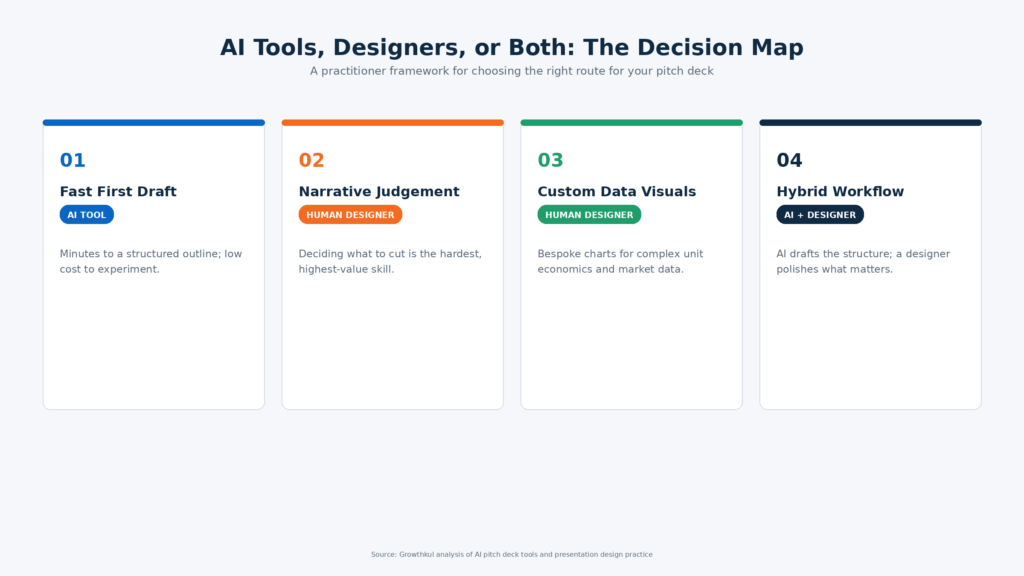
A four-card framework showing how AI tools, human designers, and a hybrid model fit different deck stages The three-way decision: speed-first, polish-first, or a blended workflow
What a Professional Designer Brings That Prompts Still Can’t
A good pitch deck designer is not primarily a layout specialist. The actual job is narrative editing: deciding which three facts about your traction matter most, cutting the other nine, and building a visual hierarchy that makes an investor’s eye land on the right number first. That is a judgement call informed by having sat through — or built — hundreds of fundraising conversations, and it is the part of the work an AI tool cannot do because it does not know which of your facts is actually your strongest argument.
Three things a professional designer typically does that prompt-based tools do not:
- Strategic cutting. Founders tend to over-explain. A designer who has seen what makes investors lose attention will cut a feature list down to the one feature that changes the pitch.
- Custom data visualisation. Templated AI charts work for simple bar and line data. A designer can build a custom visual — a market-sizing waterfall, a unit-economics bridge — that makes a complex number intuitive in one glance, something most AI tools cannot originate from scratch.
- Brand and audience calibration. A deck for a Series A VC meeting, a demo day stage, and a bank’s credit committee all need a different visual register. Designers who specialise in fundraising decks calibrate this instinctively; AI tools apply the same template logic regardless of audience.
Industry commentary from presentation design agencies is consistent on this point. Pitchworx, a presentation design firm, notes that despite advances in AI design assistance, professional pitch deck designers remain essential for strategic storytelling, understanding audience psychology, translating brand personality, and nuanced client collaboration — areas where generation tools still need a human editor directing them.
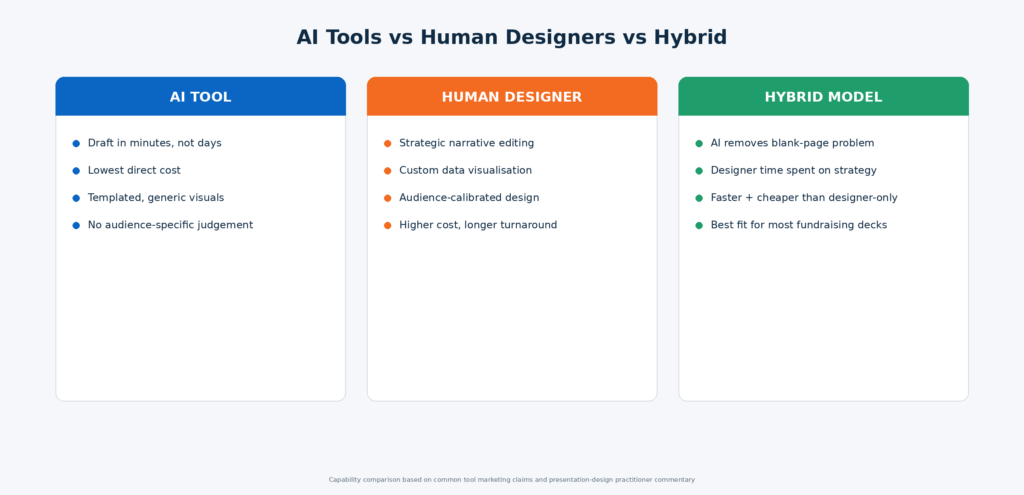
Three columns comparing AI tools, human designers, and the hybrid model across speed, judgement, and cost Where each approach is strongest, side by side
There’s also a process difference that rarely gets mentioned: a designer’s revision rounds are a form of quality control AI tools don’t replicate. When a human designer sends a first draft, you’re reacting to one coherent point of view and can push back on specific choices — “the traction slide buries the retention number” — and get a considered second version. With an AI tool, regenerating a slide often produces a different layout rather than a refined one, because the tool isn’t reasoning about why the first version didn’t work; it’s producing a new sample from the same template distribution.
The Real Trade-Off: Speed vs Judgement, Not Cheap vs Expensive
Most comparisons frame this as a budget decision. That’s not quite accurate — the deeper trade-off is between speed and judgement, and budget is just one of the costs of buying judgement.
| What you need | First thing to check | Likely right choice |
|---|---|---|
| A deck to clarify your own thinking, no external audience yet | Do you have a clear problem-solution narrative at all? | AI tool — fast, cheap, disposable drafts |
| A deck for angel or pre-seed conversations, informal setting | Is the story clear, even if the visuals are plain? | AI tool, lightly self-edited |
| A deck for a VC partner meeting or Series A/B round | Does every slide earn its place, or is there filler? | Professional designer, or AI draft + designer polish |
| A deck for a demo day or stage pitch in front of 200+ people | Will the visuals hold up on a projector from the back row? | Professional designer |
| A deck you’ll reuse and update for 12+ months across multiple rounds | Do you need a reusable brand system, not just one file? | Professional designer, built as a template |
| A sales or partnership deck, not a fundraising deck | Is design consistency more important than investor-specific psychology? | AI tool, usually sufficient |
This decision table is a practitioner heuristic, not a formula — use it as a starting filter, then weigh your specific audience and stakes.
A Worked Cost Comparison: What a 15-Slide Investor Deck Actually Costs
Numbers make this clearer than general pricing ranges. Take a hypothetical early-stage founder building a 15-slide seed-round deck, three weeks before their first investor meetings.
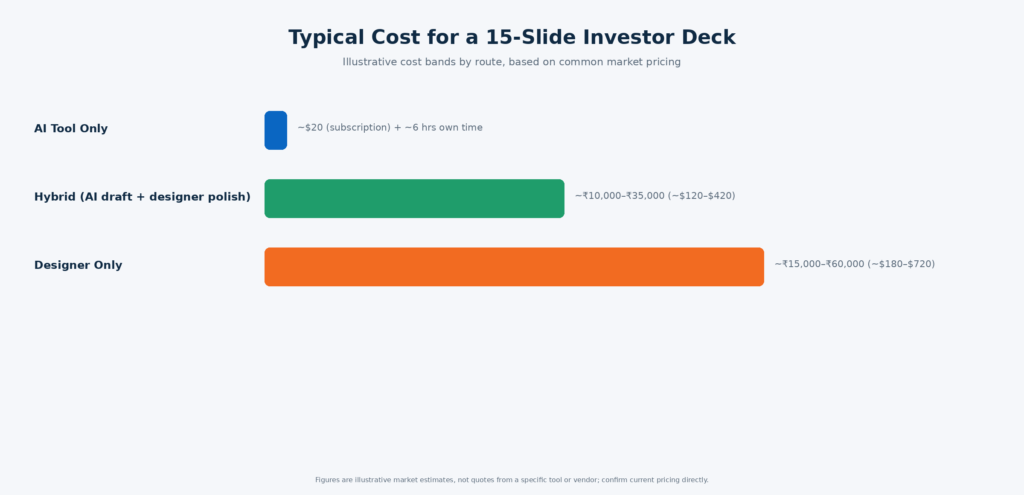
Route 1 — AI tool only. A $20/month Gamma or Alai subscription, roughly 6 hours of the founder’s own time writing prompts, regenerating slides, and manually fixing inconsistent AI-generated copy. Direct cash cost: around $20. Opportunity cost: 6 hours of founder time that could have gone to customer calls or product work.
Route 2 — Freelance designer only. A freelance pitch deck designer in India typically charges somewhere between ₹15,000 and ₹60,000 (roughly $180–$720) for a full deck, depending on experience and how many revision rounds are included, based on rates commonly quoted by Indian freelance design marketplaces and presentation design studios. Turnaround is usually 5–10 working days, with 2–3 rounds of revisions built in.
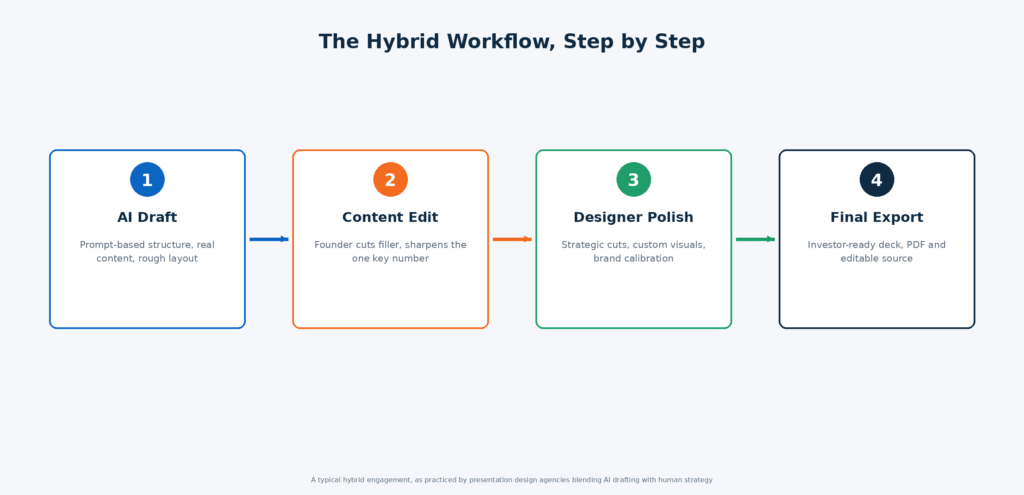
Route 3 — Hybrid (AI draft, then designer polish). The founder spends 2–3 hours in an AI tool producing a rough structural draft with real numbers and content — not final visuals. A designer is then briefed with that draft rather than a blank page, which typically cuts the designer’s quote by 30–40% because the narrative work (the slower, more expensive part) is already done, and shortens turnaround to 3–5 days. Total cost often lands around ₹10,000–₹35,000, with meaningfully better design quality than Route 1 and lower cost than Route 2.
This is a hypothetical illustration built from typical market rates, not a guarantee — actual freelancer and agency pricing varies by city, portfolio, and deck complexity. The pattern that holds across most founders’ real experience, though, is that Route 3 gives the best ratio of cost to credibility for a fundraising-stage deck.
A horizontal bar comparison of typical cost ranges for AI-only, designer-only, and hybrid pitch deck routes Rough cost bands for a 15-slide investor deck, by route
When AI Pitch Deck Tools Are Genuinely the Right Choice
Not every deck needs a designer, and treating every pitch like a Series B readout wastes money. AI tools are the sensible default when:
- You’re still finding your narrative and will rewrite the deck three or four times before it’s investor-ready.
- The audience is informal — a warm intro call, an accelerator application, an internal stakeholder update.
- Budget genuinely does not stretch to a designer yet, and a clean, consistent deck beats a polished one you can’t afford.
- You need the deck in hours, not days, and the stakes of that specific meeting are moderate.
- You’re building a sales or partnership deck where design consistency matters more than the specific visual psychology of a fundraising pitch.
When You Need a Professional Designer, Not a Prompt
The reverse list matters just as much, because the cost of a mediocre deck is highest exactly when the stakes are highest:
- You’re meeting a VC partner or fund that reviews 50+ decks a month — generic-looking decks blend into the pile.
- The deck needs to work as a leave-behind document that investors forward internally without you in the room to narrate it.
- You have genuinely complex data — unit economics, a multi-sided marketplace, technical IP — that needs custom visualisation, not a templated chart.
- You’re raising a priced round where the deck will be scrutinised line by line, not skimmed.
- You need one deck that gets reused and lightly updated across 6–12 months, which rewards investing in a proper template and brand system once.
The Hybrid Model Is Where Most Experienced Founders Land
Framing this as AI-versus-designer undersells how the market is actually moving. Pitchworx’s own analysis of the presentation design industry notes that by 2026, analysts predict 85% of professional presentation design agencies will operate on a hybrid model, combining AI-assisted drafting with human strategic direction — not replacing designers with AI, and not ignoring AI either.
The same analysis cites an internal case comparison showing a traditional 40-hour design process cut to roughly 15 hours with AI assistance built into the workflow — a time reduction of about 62.5%, with a corresponding cost reduction of roughly 40%, when AI handles first-draft layout and a human designer handles strategy, editing, and final polish.
That’s the practical shape of the hybrid approach: AI removes the blank-page problem and the formatting grunt work; the designer spends their time on the 20% of decisions — which number to lead with, which slide to cut entirely — that actually change whether the deck lands.
A flow diagram showing the hybrid workflow from AI draft to content edit to designer polish to final export How most hybrid engagements actually run, start to finish
A Cadence Checklist: What to Revisit, and When
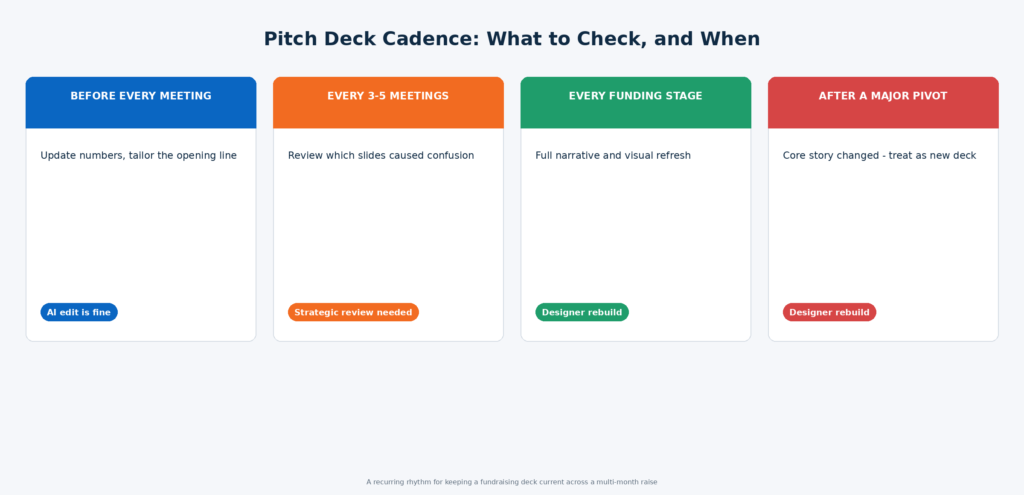
A pitch deck is not a one-time asset if you’re raising over several months or multiple rounds. This cadence helps decide when AI edits are enough and when it’s worth bringing a designer back in.
| Cadence | What to check | AI tool sufficient? |
|---|---|---|
| Before every individual meeting | Update traction numbers, tailor the opening line to the investor | Yes — quick AI edit is fine |
| After every 3–5 investor meetings | Review which slides prompted confused questions | No — worth a strategic review with a designer or advisor |
| Every funding stage (pre-seed → seed → Series A) | Full narrative and visual refresh, not just updated numbers | No — rebuild with a designer |
| Quarterly, even outside active fundraising | Keep one “evergreen” version current for inbound investor interest | Yes — AI tool for minor refresh |
| After a major pivot or new product launch | Core story has changed — treat it as a new deck, not an edit | No — designer rebuild recommended |
A Myth Worth Correcting: “AI Decks Convert Just as Well as Designed Ones”
A common claim in AI-tool marketing is that generated decks perform comparably to professionally designed ones once the content is solid, implying design quality barely affects investor response. This isn’t well supported by what presentation design practitioners actually report. Pitchworx’s comparison of AI tools and human designers argues the opposite: that for high-stakes scenarios, the nuance provided by professional design services often proves invaluable, precisely because investor attention is a scarce resource, and generic-looking decks lose a disproportionate share of that attention in the first ten seconds.
The honest framing is narrower than either extreme: content quality is necessary but not sufficient. A strong story in a generic-looking deck can still underperform the same story told with deliberate visual hierarchy — not because investors are shallow, but because a confusing or forgettable layout makes them work harder to find the argument, and partners skimming dozens of decks a week don’t always do that extra work.
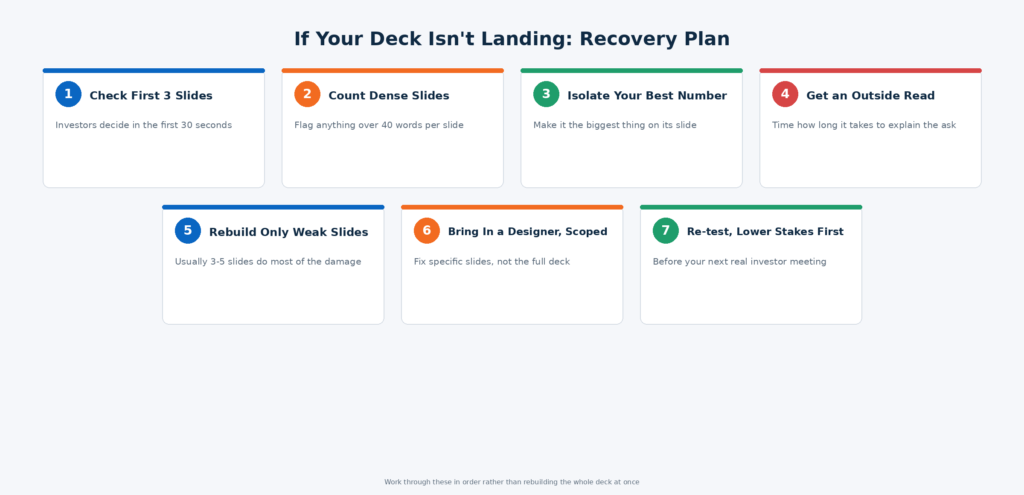
A seven-step recovery plan grid for fixing a pitch deck that isn’t landing with investors What to fix first if your deck isn’t getting second meetings
If Your Deck Isn’t Landing: A Recovery Plan
If you’ve already sent out an AI-built deck and aren’t getting traction, work through this in order rather than rebuilding everything at once:
- Check the first three slides alone. Most investors decide whether to keep reading within the first 30 seconds — if the problem and solution aren’t instantly clear, nothing downstream matters yet.
- Count your slides with more than 40 words. AI tools tend to over-write; any slide an investor has to actually read rather than glance at is a candidate for cutting by half.
- Isolate your single strongest number (revenue, growth rate, retention, a signed LOI) and confirm it’s visually the biggest thing on its slide — not buried in a paragraph.
- Get one outside read from someone outside your company who hasn’t seen the deck before, and time how long it takes them to say what you do.
- Rebuild only the weak slides, not the whole deck — usually three to five slides are doing most of the damage, not all fifteen.
- Bring in a designer for those specific slides rather than the full deck, if budget is tight — targeted fixes cost a fraction of a full rebuild.
- Re-test with a smaller, lower-stakes audience before your next real investor meeting, if time allows.
India-Specific Notes
A few things worth flagging specifically for Indian founders and marketing teams, since pricing and norms differ from the largely US-centric advice most of these comparisons are written for:
- Freelance design marketplaces such as those used by Indian startups typically quote full pitch decks in INR rather than USD, and rates vary significantly between Tier-1 city freelancers and smaller-market designers — it’s worth getting at least two quotes before committing.
- Most AI pitch deck tools bill in USD, which means currency fluctuation and international card fees can make a “$10/month” tool cost meaningfully more than the headline number suggests; a few tools now offer INR billing through Indian payment processors, worth checking before subscribing.
- Indian investor decks tend to run leaner on visual flourish and heavier on unit economics and path-to-profitability slides compared to Silicon Valley norms, which plays to professional designers’ strength in custom data visualisation rather than AI templates.
- Demo day and accelerator culture in India (Y Combinator-style cohorts, state-run startup programmes) often has tight, non-negotiable deck deadlines, where an AI-first draft followed by a short, scoped designer review is usually the realistic approach rather than a full bespoke build.
(These points are India-specific and can be removed for an international version of this content.)
One-Page Summary: AI Tool, Designer, or Hybrid
| Factor | AI Tool | Professional Designer | Hybrid |
|---|---|---|---|
| Typical cost (15-slide deck) | $10–30/month subscription | ₹15,000–₹60,000 per deck | ₹10,000–₹35,000 per deck |
| Turnaround | Minutes to hours | 5–10 working days | 3–5 working days |
| Best for | Early drafts, informal meetings, iteration | High-stakes fundraising, demo stages, reusable templates | Most fundraising-stage decks |
| Visual originality | Templated, can look generic | Custom, audience-calibrated | Custom polish on an AI-sped structure |
| Narrative judgement | Minimal — needs heavy human editing | Strong — this is the core skill | Strong, applied efficiently |
| Revision flexibility | Instant self-edits | Scoped revision rounds, usually 2–3 | Fast AI edits + scoped designer rounds |
A four-column cadence checklist showing when to use AI tools, designer reviews, full rebuilds, and quarterly refreshes Matching the right fix to the right moment in your fundraising calendar
Conclusion
The honest answer to “AI pitch deck tools vs professional design” is that most founders shouldn’t pick one permanently — they should match the tool to the stage. Use AI tools to move fast on early drafts, informal meetings, and narrative testing, where speed and low cost matter more than polish. Bring in a professional designer when the stakes rise: priced rounds, demo stages, and decks that need to survive being forwarded around a partner meeting without you there to explain them. If you’re at that second stage and want a deck built by people who do this daily rather than a template stretched to fit your business, Growthkul’s Pitch Deck Design team builds investor-ready decks that start from your actual numbers and narrative, not a generic prompt. Whichever route you take first, treat your deck as a living document — the version that gets you a second meeting is rarely the first one you build.
