
A brand refresh updates your logo, colours, typography, and messaging while your positioning and name stay exactly as they are. A full rebrand goes deeper — it rewrites your name, your positioning, or the story you tell the market, and the visual identity is just the part customers notice first. Most Indian B2B companies that think they need a rebrand actually need a refresh, and most that settle for a refresh are quietly avoiding a harder, more necessary conversation about positioning.
That confusion is expensive. Pick the wrong one and you either spend six figures solving a problem a new logo would have fixed, or you spend two lakhs on a cosmetic update while the actual reason customers are confused — your positioning — stays untouched. This guide breaks down the real difference, what each option costs and takes in India specifically, and gives you a straightforward way to decide which one your business needs before you brief a single designer.
A Brand Refresh Changes How You Look, Not Who You Are
Business owners often reach for “rebrand” when what they actually mean is “our brand looks tired.” That distinction matters because it changes the entire budget, timeline, and team you need.
A brand refresh keeps your company name, your core positioning, and the promise you’ve built your reputation on completely intact. What changes is the expression of that promise — a sharper logo mark, an updated colour palette, modern typography, refreshed photography, and tightened messaging that sounds like 2026 instead of 2016. Your customers should recognise you immediately after a refresh; it should feel like the same business, just better presented.
The trigger for a refresh is almost always cosmetic fatigue rather than strategic confusion. Your website looks dated next to competitors. Your logo doesn’t scale well on mobile or social. Your brand guidelines are a decade old and nobody in the team follows them consistently anymore. None of that means your positioning is broken — it means your execution has aged.
Refresh projects for small and mid-sized businesses typically run £2,000 to £15,000 in markets like the UK, according to Huddle Creative’s 2026 pricing breakdown, and are usually completed within one to two months — far shorter than a full rebrand, which the same source puts at up to six months for complex projects. In US dollar terms, a visual refresh (logo update, palette, typography, templates) lands between $5,000 and $25,000, per Red Shoes’ 2026 branding pricing guide cited by Webtonic’s rebranding benchmarks report. For an Indian B2B company working with a regional design agency rather than a global consultancy, that range compresses considerably — but the proportions hold: a refresh should always cost a fraction of what a full rebrand costs, and take a fraction of the time.
A refresh scope usually includes a handful of clearly bounded deliverables: an updated or tightened logo mark (rarely a complete redraw), a modernised colour and typography system, revised templates for decks, proposals and invoices, a redesigned website front-end on the existing information architecture, and a messaging pass that doesn’t touch the core positioning statement. Nothing in that list requires a Registrar of Companies filing, a new trademark class, or a GST amendment — which is precisely why the timeline and budget stay contained. The moment a “refresh” conversation starts including a new name, a new tagline that repositions the company, or a new target segment, it has quietly become a rebrand, and the budget conversation needs to restart from that point.
A Full Rebrand Changes What You Stand For
A rebrand is a different animal entirely. It happens when the business itself has changed — a pivot in what you sell, a merger, an expansion into a market your old name doesn’t fit, or a reputation problem serious enough that a new coat of paint won’t solve it. The visual identity still changes, often dramatically, but it changes because the strategy underneath it changed first, not the other way around.
This is the single biggest mistake companies make: starting with the designer instead of starting with the “why.” A rebrand without a strategy session beforehand is just an expensive refresh wearing a bigger label. The actual sequence should be positioning and research first, then naming (if the name is changing), then the identity system, then rollout.
Full rebrand costs scale with company size far more sharply than refresh costs do. Inkbot Design’s 2026 cost breakdown puts a small-business full rebrand with strategy work at $10,000 to $75,000, while mid-sized companies commonly spend $50,000 to $500,000. Ignyte Brands’ agency pricing guide separates this into tiers, with a mid-level “brand reboot” — strategy, naming exploration, full identity, and rollout support — running $150,000 to $250,000-plus over six to eight months. Bynder’s 2026 survey of over 1,000 marketers found the average rebrand touches around 215 brand assets and takes roughly seven months from the first internal conversation to full rollout, a timeline most Indian founders underestimate by half.
For Indian mid-market companies specifically, IRPR Agency’s 2026 pricing commentary cites an average rebrand spend of roughly ₹12.5 lakh among brands in the ₹20–100 crore revenue band, up around 18% from 2024 — though this figure comes from a single agency’s own client data rather than an independent industry survey, so it’s worth treating as a directional benchmark rather than a market-wide average. What’s consistent across every source, Indian and international, is the shape of the cost curve: strategy and research sit at the base, naming (if needed) adds a distinct line item, the identity system sits in the middle, and legal and compliance updates — the part most founders forget to budget for entirely — sit on top. Skipping the research phase to save money is also, per Pivitt’s Brand Transformation Statistics 2026 report (citing Nielsen data), a leading reason UK rebranding campaigns fail: the report found roughly 40% of rebrands don’t deliver a positive return, with weak strategic foundations named as the primary cause.
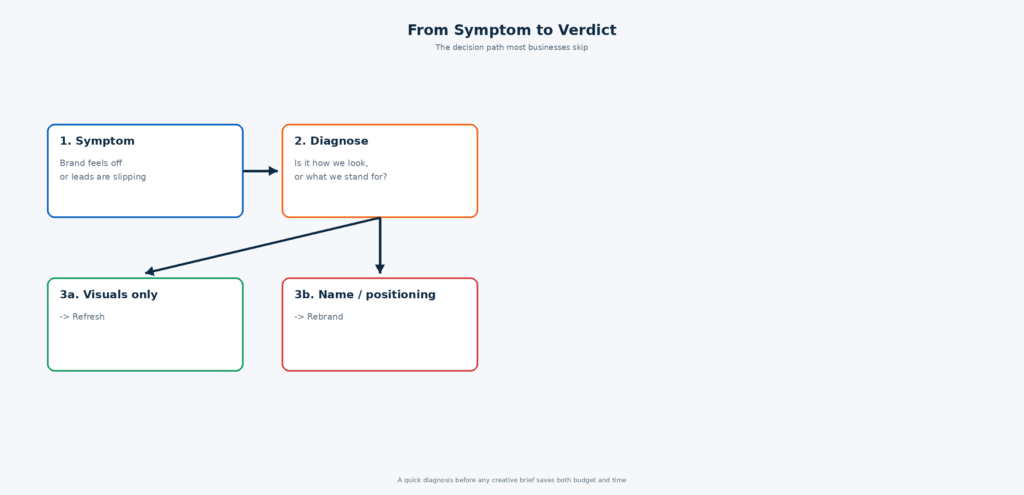
The Diagnosis Table: What You’re Seeing vs What You Actually Need
Most businesses don’t start with “should we refresh or rebrand” — they start with a symptom. The logo looks old. Leads are drying up. A competitor just launched something sharper. The job is tracing that symptom back to its actual cause, because the same symptom can point to completely different fixes.
| Symptom you’re noticing | What to check first | Usually points to |
|---|---|---|
| Logo and website look dated next to competitors | Is the core offer and customer still the same? | Refresh |
| Sales team says prospects don’t “get” what you do in one line | Is this a messaging problem or a market-fit problem? | Rebrand (if market-fit), Refresh (if just messaging) |
| Company has pivoted to a new product line or vertical | Does the current name still describe the business? | Rebrand |
| Brand looks inconsistent across teams, cities, or sales decks | Is there a brand guideline, and is anyone using it? | Refresh |
| Merger or acquisition has brought two identities together | Are both audiences and positioning being merged, or just visuals? | Rebrand |
| Negative press or reputation damage tied to the current name | Is the damage tied to the name/identity, or to actual service delivery? | Rebrand only fixes name association, not delivery issues |
| Younger competitors are winning deals your product should win | Is it a perception problem or a genuine product gap? | Refresh (perception), deeper work (product gap) |
This is a diagnostic starting point, not a verdict — a genuine strategy audit with customer interviews and competitive research should confirm it before you commit budget either way.
What a Rebrand Actually Touches in India — the Compliance Cascade Nobody Budgets For
This is where Indian businesses get caught out, and it’s the one thing most international branding guides skip entirely. If your rebrand includes a name change, the design work is the smaller half of the project. The compliance cascade is the larger, slower half.
Changing a registered company’s name in India starts with an RUN (Reserve Unique Name) application and board approval, followed by filing Form INC-24 with the Registrar of Companies. Once the new Certificate of Incorporation is issued, incorpx.io’s step-by-step compliance guide lists the downstream updates required: GST registration amendment (via Form GST REG-14, which must be filed within 15 working days of the name change), PAN and TAN correction with the Income Tax Department, EPFO and ESIC record updates, bank account and cheque book updates, and amendment of any trademark filings under the old name.
The trademark piece deserves its own line item. India classifies trademarks under the Nice Classification system across 45 separate classes — software typically falls under Class 9, for instance — and a name can be fully available in one class while already registered in another, according to legal guidance published by Tata NeuArc’s MSME blog. Updating a proprietor or ownership record on an existing trademark costs roughly ₹9,000 for e-filing per the same source, and a full trademark amendment filing through the Trademark Registry commonly takes 30 to 60 days, separate from the company name change itself.
None of this is a reason to avoid a necessary rebrand. It’s a reason to budget six to eight weeks of pure compliance runway on top of the creative timeline, and to involve your company secretary or compliance consultant in week one — not after the new logo is already printed on your invoices.
Seven-step grid showing the post-rebrand compliance cascade in India: ROC, PAN, GST, trademark, bank, EPFO, signage What actually has to change after an Indian company’s legal name changes

A Practitioner’s Note: Why Agencies Sometimes Oversell the Rebrand
This section is a practitioner observation, not a sourced statistic — treat it as one experienced opinion among several, not an industry-wide fact. A full rebrand is a larger, more profitable engagement than a refresh for almost any design agency, which creates a quiet incentive to frame a company’s problem as bigger than it is. That doesn’t mean agencies are acting in bad faith; a genuinely ambitious creative team often wants to solve the deeper problem, even when the client only asked for a logo update.
The practical defence is procedural, not adversarial: ask any agency proposing a full rebrand to show the research that identified the positioning problem, separately from the creative concepts. A credible rebrand proposal leads with findings — customer interviews, competitive gaps, a specific articulation of what’s broken in the current positioning — before it leads with mood boards. If the first deck you receive is all visual direction and no diagnosis, that’s worth a direct question before signing off on the bigger budget.
A Worked Example: A Pune SaaS Company Weighing Both Options
The following is a hypothetical, illustrative scenario — not a real client case study — built to show how the decision plays out with actual numbers.
Consider a Pune-based B2B SaaS company, originally built around HR payroll software for small businesses, that has spent the last eighteen months expanding into full HR compliance and workforce management for mid-sized manufacturers. Revenue has grown, but half of inbound leads still ask “do you only do payroll?” — the old positioning is actively costing them deals in their new, higher-value segment.
Two paths are on the table. A refresh — new logo, new site, sharper messaging, same name — is quoted by a regional agency at roughly ₹8–12 lakh and a six-week timeline. A full rebrand with a new name reflecting the broader platform, including legal name change, trademark refiling under the correct Nice class, and a complete identity system, is quoted at ₹25–35 lakh and a four-to-five-month timeline once GST and trademark amendment windows are factored in.
The deciding question isn’t the budget gap — it’s whether “payroll” in the name is the actual source of lost deals. If prospects are confused by the name itself, a refresh changes nothing; the website will still say “payroll” between the lines. In this hypothetical, the company goes with the rebrand, because the mismatch is structural: the name describes a product they’ve outgrown, not a design that’s gone stale. A company in the same revenue bracket whose only problem is an outdated logo and inconsistent sales decks would make the opposite call and save the better part of ₹20 lakh.
Myth: “We Changed Our Logo, So We Rebranded”
This is the single most common misuse of the word, and it matters because it leads companies to under-invest in the strategy work a real rebrand needs while believing they’ve already done it.
Changing a logo is a design decision. A rebrand is a strategy decision that happens to produce a new logo as one of its outputs. Fabrik Brands’ long-running guide to the distinction puts it plainly: rebranding uses research and brand strategy to build a new identity from the ground up, while a refresh updates the existing identity without touching the underlying strategic position. A company that swaps its logo without revisiting positioning, audience, or messaging hasn’t rebranded — it has refreshed, whether that was the intention or not, and should budget and plan accordingly rather than promising stakeholders a transformation the project was never built to deliver.
The practical fix is simple: before any creative brief goes out, write down in one sentence what is strategically changing about the business, separate from what the brand will look like. If that sentence is empty, the project is a refresh.
The Cadence Checklist: What to Revisit, and How Often
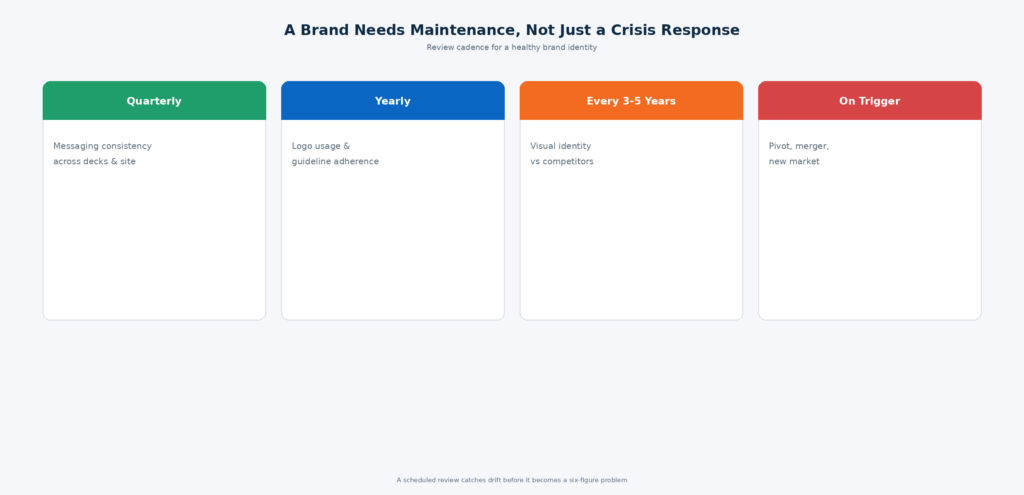
Neither a refresh nor a rebrand should be a one-time panic response. Brands that stay relevant treat their identity as something to maintain on a schedule, not something to overhaul only when it starts to hurt.
| Cadence | What to review | Typical action |
|---|---|---|
| Quarterly | Messaging consistency across sales decks, website, and social | Small copy and template fixes, no design budget needed |
| Yearly | Logo usage, brand guideline adherence across teams and cities | Internal audit; flag drift before it compounds |
| Every 3–5 years | Visual identity relevance vs current competitors and customer expectations | Brand refresh, if positioning is still sound |
| On a strategic trigger (pivot, merger, new market, reputation event) | Whether the name and positioning still describe the business | Full rebrand evaluation, starting with strategy, not design |
If You Choose Wrong: The Recovery Plan
Sometimes the call gets made under pressure and turns out to be the wrong one — a company refreshes when it needed to rebrand, or launches a full rebrand when a lighter touch would have worked. Neither mistake is fatal if it’s caught early.
If a refresh didn’t fix the underlying confusion: Resist the instinct to immediately escalate to a second, bigger rebrand. First confirm the diagnosis — talk to the sales team and a handful of recent lost deals about what actually confused them. If it’s genuinely positioning, not polish, that’s when a rebrand conversation starts, backed by evidence instead of a hunch.
If a rebrand was launched without proper research: Pause before the identity rolls out company-wide. A rebrand that skipped the strategy phase can often be corrected by slotting in a condensed positioning sprint — two to three weeks of customer and competitor research — before the new identity goes live externally, rather than scrapping the creative work entirely.
If budget ran out mid-rebrand: Roll out the name and positioning changes first, since those carry the strategic weight, and treat the full visual system as a phased refresh over the following two quarters rather than delaying the entire launch.
If internal teams resist the change: This is nearly always a sign the “why” wasn’t communicated before the “what.” Loop department heads into the positioning rationale before showing them final designs, even late in the process — resistance to a new look is usually resistance to a decision they didn’t feel part of.
Your One-Page Decision Checklist
| Question | If yes → | If no → |
|---|---|---|
| Has the core product, audience, or positioning changed in the last 12–18 months? | Lean rebrand | Lean refresh |
| Does your current name still accurately describe what you sell? | Refresh is enough | Rebrand needed |
| Is the complaint “it looks old” rather than “I don’t understand what you do”? | Refresh | Rebrand |
| Are you merging with, or being acquired by, another company? | Rebrand | Refresh |
| Can you write one sentence describing a strategic change, not just a visual one? | Rebrand | Refresh |
| Is your current budget under ₹15 lakh and timeline under two months? | Scope to refresh | Plan for rebrand timeline/budget |
| Will the name change trigger ROC, GST, PAN, and trademark amendments? | Budget 6–8 extra weeks for compliance | Design-only refresh timeline applies |
Making the Call
The honest answer for most Indian B2B companies reading this is that they need a refresh and are tempted by a rebrand because it feels more decisive. A rebrand is the right call only when something structural about the business — the name, the audience, the offer — has genuinely outgrown what the brand currently says. Everything else is a refresh wearing a bigger price tag.
Start with the diagnosis table, not the mood board. Get honest answers from your sales team about where deals actually stall, write down the one sentence that captures what’s strategically different about your business today versus when the brand was built, and only then bring in a design partner. If you want a second opinion on which path fits your situation, Growthkul’s brand-identity-design-agency team runs this diagnosis as the first step of every engagement — before a single logo concept gets drawn — so the budget goes toward the problem that’s actually costing you deals.
