
No, product design and industrial design are not the same thing, though the overlap is large enough that even experienced practitioners disagree on where one ends and the other begins. The short version: industrial design is the older, narrower discipline focused on the form, ergonomics, and manufacturability of physical, mass-produced goods. Product design is the broader, newer umbrella that includes industrial design but also covers digital products, user experience, and the end-to-end journey from concept to customer — physical or not.
If you’re hiring for a role, briefing an agency, or just trying to understand what’s on a designer’s business card, that distinction matters more than it looks. This article breaks down where the two genuinely differ, where they overlap so much the difference stops mattering, a worked example of both roles touching the same physical product, and what the terminology means specifically if you’re hiring in India.
The Short Answer: Overlapping Fields, Different Centres of Gravity
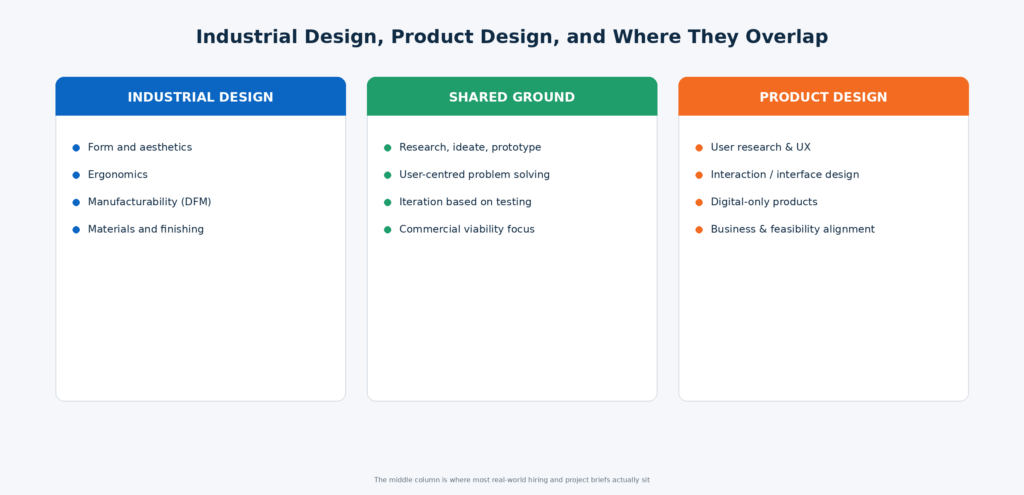
Picture two circles that overlap by roughly 70%. Industrial design sits almost entirely inside product design’s territory, but product design extends well beyond industrial design’s boundaries into software interfaces, service design, and digital-only products that never touch a factory floor.
Industry commentary consistently frames this as a scope difference rather than a skill difference. One recurring framing across design-agency sources is that industrial design is about taking a solution through manufacture and to the end user, while the conceptual development that precedes it is closer to product design — meaning the two aren’t competing definitions so much as different stages of the same pipeline, viewed from different angles depending on who’s doing the talking.
That ambiguity is real, not a marketing simplification. Practitioner forums such as Core77 have run polls for over a decade asking designers whether product design is a subset of industrial design, the reverse, or neither — and the responses split roughly evenly across all options. There is no single accepted answer industry-wide. What follows is the most commonly used working distinction, not a definitive ruling.
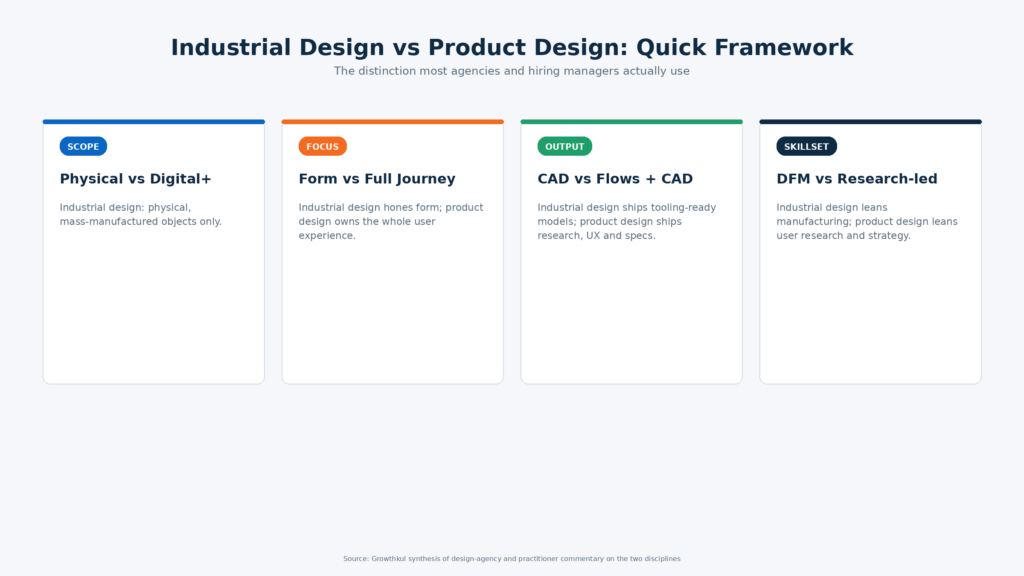
A four-card comparison of industrial design and product design across scope, focus, output, and skillset The core distinction most agencies and hiring managers actually use
What Industrial Design Actually Covers
Industrial design emerged in the early 20th century alongside mass manufacturing, and its DNA still shows. The discipline is centred on physical, manufactured objects — furniture, appliances, vehicles, consumer electronics, medical devices — and the job is to make those objects look right, feel right in the hand, and come off the production line at a workable cost. It’s a discipline born from a very specific commercial pressure: once factories could produce identical goods at scale, the object’s form became a competitive lever in its own right, not an afterthought bolted onto engineering. That history is why industrial design training still leans heavily on materials science, manufacturing processes, and model-making, even at design schools that have modernised most of the rest of their curriculum.
Typical responsibilities include:
- Form and aesthetics. Shape, proportion, material, finish, and colour, tuned to brand and target market.
- Ergonomics. How a human body interacts with the object — grip, weight distribution, reach, comfort over repeated use.
- Manufacturability (DFM). Designing for the realities of injection moulding, sheet metal, casting, or whatever process will actually produce the part at volume, so the design that looks good in a render also comes off the line without defects.
- Materials and finishing. Selecting materials for cost, durability, and manufacturing compatibility, not just appearance.
An industrial designer’s output is usually a physical or near-physical artefact: CAD models, prototypes, tooling-ready drawings, material specifications. The job exists because a product can be functionally sound and still fail commercially if it looks wrong, feels awkward, or costs too much to produce at scale.
What Product Design Actually Covers
Product design is the newer, broader term, and its growth tracks the rise of software. A product designer today might never touch a physical object — their “product” could be a mobile app, a SaaS dashboard, or a subscription service, and their job is to make the entire experience of using that product work, end to end.
Where industrial design asks “does this object look right and manufacture well,” product design asks a wider question: “does this entire experience solve the user’s problem, and is it something they’ll keep using?” That typically covers:
- User research and problem definition. Understanding what the user actually needs, often before any visual design begins.
- User experience (UX) and interaction design. How someone moves through a product — screens, flows, physical controls, or a mix of both.
- Visual and interface design. For digital products, this overlaps heavily with UI design; for physical products, it overlaps with industrial design’s form and aesthetics work.
- Business and feasibility alignment. Product designers are often expected to think about commercial viability and technical feasibility alongside desirability — a three-way balance borrowed from classic design-thinking frameworks.
A useful way to state the scope difference plainly: industrial design almost always means physical goods; product design can mean physical goods, digital products, or both at once, with the emphasis on the complete user journey rather than the object alone.
This broadening happened largely because of how the tech industry grew. As software companies scaled through the 2000s and 2010s, they needed a design function that thought about the whole product experience — not just screens, but onboarding, retention, and how design choices tied back to business metrics. “Product design” was the term that stuck, partly because “industrial design” carried too strong an association with physical manufacturing to describe someone whose entire output was Figma files and user flows. The title migrated into tech first, then spread outward to any company — hardware or software — that wanted a designer thinking about the full product rather than just one layer of it.
Three columns showing industrial design, product design, and where the two overlap Two circles with a wide shared middle, not two separate fields
Where the Two Overlap So Much the Label Stops Mattering
For a huge share of real-world hiring and project briefs, this entire distinction is academic. A startup building a physical hardware product — a smart home device, a wearable, a kitchen gadget — needs someone who thinks about user needs (product design territory) and someone who can get it manufactured at the right cost with the right feel in hand (industrial design territory). In practice, this is frequently the same person, especially at smaller studios and startups, where one generalist designer or a small team covers both halves of the job under whichever job title the company happens to use.
Both fields also share the same underlying mindset: define the user’s real problem, generate and test multiple solutions, iterate based on feedback, and ship something that’s commercially viable, not just elegant on paper. That shared process — research, ideate, prototype, test, refine — is arguably a bigger commonality between the two fields than any specific skill gap separates them.
This is also why job titles are such an unreliable guide in practice. Two designers with near-identical day-to-day work can carry different titles purely because of where they studied, which industry they entered first, or what a particular company’s HR system happened to default to when the role was created. A designer trained at a traditional industrial design programme who later moved into a connected-hardware startup might carry the “product designer” title despite spending most of their time on physical form and ergonomics — because that’s simply what the company calls every designer on the team, regardless of specialisation. The reverse happens just as often: a UX-trained product designer at a hardware company might get labelled “industrial designer” on a business card because that’s the client-facing term the agency has always used. None of this means the underlying skill distinction has disappeared — it means the label on a resume or job posting is a weaker signal than the actual portfolio and process behind it.
A Decision Table: Which Term Should You Actually Use?
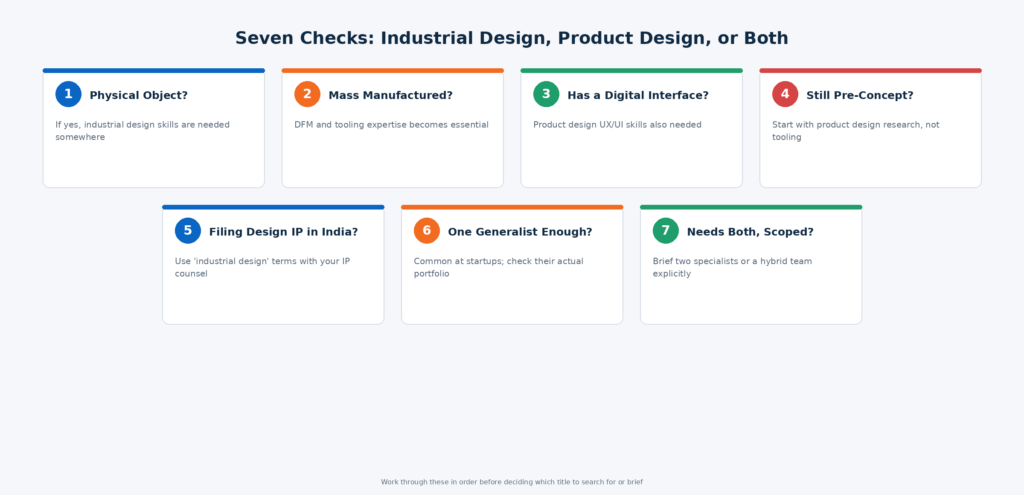
If you’re hiring, searching, or briefing a project, use this as a first filter rather than agonising over the “correct” definition.
A seven-step grid of checks for deciding whether you need industrial design, product design, or both Work through these checks before writing a job posting or project brief
| What you’re building or hiring for | First thing to check | Term to search for |
|---|---|---|
| A physical consumer product going to mass manufacture | Do you need CAD, DFM, and materials expertise? | Industrial design |
| A mobile app, website, or SaaS product | Is there no physical object involved at all? | Product design (UX/UI focus) |
| A connected hardware device (app + physical unit) | Does the work span both software and physical form? | Product design generalist, or a team covering both |
| A single piece of furniture, appliance, or vehicle component | Is the priority appearance, ergonomics, and producibility? | Industrial design |
| A startup’s very first MVP, pre-manufacturing | Are you still validating the concept, not tooling it? | Product design |
| A design patent or registered design filing | Is legal protection for the object’s appearance the goal? | Industrial design (the legal term used in filings) |
This table reflects common practice, not a formal standard — titles vary by company, region, and individual preference, so always confirm what a specific designer or agency actually does rather than relying on their job title alone.
A Worked Example: One Smart Kettle, Two Design Roles
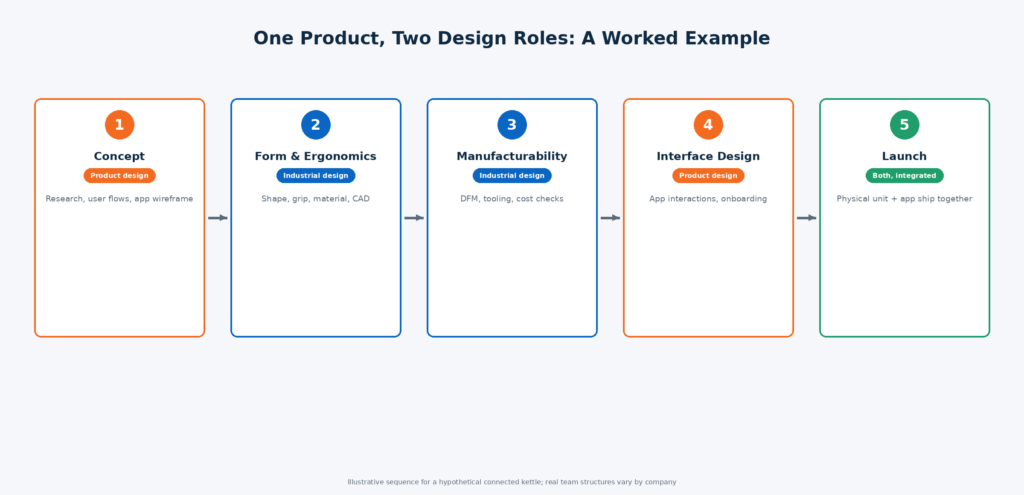
To make the distinction concrete, follow a hypothetical connected kettle from idea to shelf.
Stage 1 — Problem definition and concept (product design). The team researches how people actually use kettles — convenience pain points, app-control expectations, safety concerns — and defines the product’s core value proposition: a kettle that reaches a precise temperature and notifies your phone. This stage produces user flows, rough sketches, and an app wireframe. No manufacturing constraints are considered yet.
Stage 2 — Form and ergonomics (industrial design). The physical kettle’s shape, handle grip, spout angle, and material (likely a heat-resistant polymer plus stainless steel) get refined through CAD and prototyping. The designer checks that the handle doesn’t heat up, that the base fits standard kitchen counters, and that the silhouette matches the brand’s existing product line.
Stage 3 — Manufacturability review (industrial design). The design is checked against injection-moulding tolerances, wall-thickness requirements, and assembly cost. A feature that looked good in the render — a complex curved spout — gets simplified because it would require an expensive multi-part mould.
Stage 4 — Interface and app design (product design). In parallel, the companion app’s interaction design is finalised: how a user sets a target temperature, what the notification looks like, how onboarding works on first use. This has nothing to do with manufacturing and everything to do with product design’s broader UX scope.
Stage 5 — Integration and launch. Both halves come together: the physical kettle and the digital app ship as one coherent “product,” built by what was likely, in a real startup, a mix of product designers and industrial designers — or a small team wearing both hats depending on the day.
This sequence is illustrative, not a universal process every company follows exactly — team structure, outsourcing, and company size all change how these stages are actually divided.
A five-stage flow diagram showing a product moving from concept through industrial design to launch How the two disciplines typically hand off on a real connected-hardware project
A Myth Worth Correcting: “They’re Just Two Names for the Same Job”
A claim that circulates often, especially in casual design-community discussions, is that industrial design and product design are simply interchangeable labels for identical work — pick whichever sounds more modern. This oversimplifies a real, if blurry, distinction. As one long-running Core77 practitioner discussion on the topic put it, the honest answer is contested even among professional designers themselves, with some arguing product design is a subset of industrial design, others arguing the reverse, and plenty landing on “it depends who you ask, where they’re from, and where they studied.”
What is more defensible than either extreme: the two terms are not formally interchangeable, because product design’s scope now routinely includes work — pure software UX, service design, zero physical component — that falls entirely outside what industrial design has ever covered, even under its broadest historical definitions. Calling a mobile-app-only designer an “industrial designer” would be a genuine mismatch; calling a furniture or appliance specialist a “product designer” is looser but defensible, because physical-goods work is still inside product design’s broader umbrella.
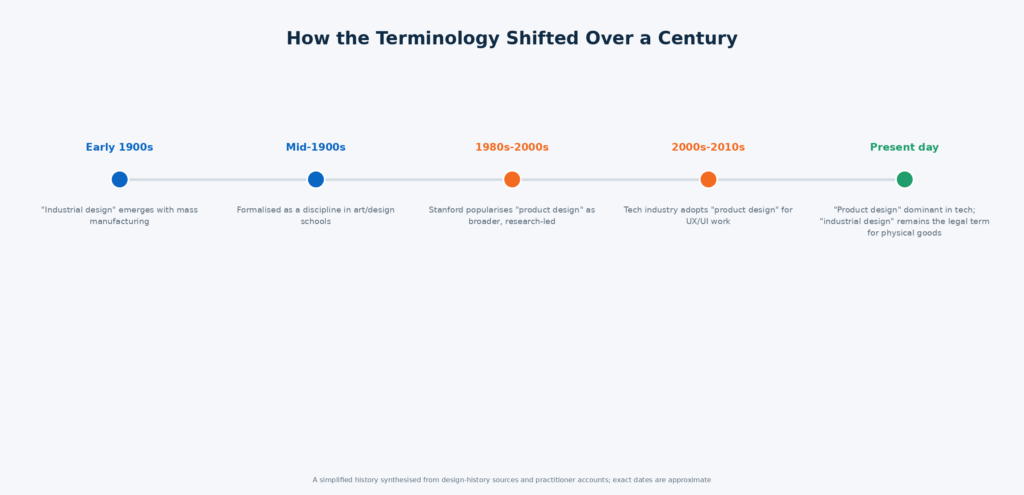
Timeline: How the Terminology Shifted
| Period | What changed |
|---|---|
| Early 20th century | “Industrial design” emerges alongside mass manufacturing, led by figures like Raymond Loewy, applying aesthetic and ergonomic thinking to factory-produced goods. |
| Mid-to-late 20th century | Industrial design consolidates as a formal discipline taught in art and design schools, centred on physical consumer goods. |
| 1980s–2000s | Stanford and similar programmes popularise “product design” as a broader, more engineering- and user-research-integrated alternative to traditional industrial design training. |
| 2000s–2010s | The rise of software and the smartphone pulls “product design” toward digital UX/UI work, as tech companies adopt the title for designers who’ve never touched CAD. |
| Present day | “Product design” is the dominant term in tech hiring and often covers digital-only work; “industrial design” remains the specific, legally recognised term for physical-object design, including in design-patent filings. |
A timeline of dots showing how industrial design and product design terminology evolved over the past century Why the same work gets called two different things depending on when and where you trained
India-Specific Notes
A few things are worth flagging specifically for Indian founders, hiring managers, and design students, since both the legal terminology and the talent market differ from the Western sources most comparison articles draw from:
- “Industrial design” is the formal legal term in Indian IP law. Under the Designs Act, 2000, the appearance of an article is protected as a “design,” and the registration process and terminology explicitly use “industrial design” language — this matters if you’re filing for design protection on a physical product, where using the correct legal term in communication with an IP professional avoids confusion.
- India’s design education pipeline still leans “industrial design” in naming. Institutes such as NID (National Institute of Design) and the IITs’ design programmes often use “Industrial Design” as a formal degree or department name, even though graduates commonly go on to do what the global tech industry calls “product design,” including UX and digital work.
- Hiring costs and title usage vary significantly between Indian startups and MNC design studios. Startups building software products almost always hire under the “product designer” title, including for roles with zero physical-product scope; hardware and consumer-goods companies, and most freelance/agency engagements for physical products, still default to “industrial designer.”
- If briefing an Indian design agency for a physical product, it’s worth explicitly stating whether you need manufacturability and DFM expertise (industrial design strength) or broader user-research-led product strategy (product design strength) — agency portfolios often blend both, but their default working process differs depending on which they lead with.
- The domestic manufacturing push has widened demand for industrial design specifically. As more Indian consumer-goods and electronics brands move design and tooling work in-house or to local agencies rather than importing finished designs, the specific manufacturability and DFM skills that define industrial design — rather than the broader product-strategy skills of product design — are increasingly in demand on their own, not just bundled into a generalist product design hire.
Skills and Career Snapshot
A four-column snapshot comparing tools, concerns, education, and demand between industrial design and product design Where each discipline’s tools, training, and job demand concentrate
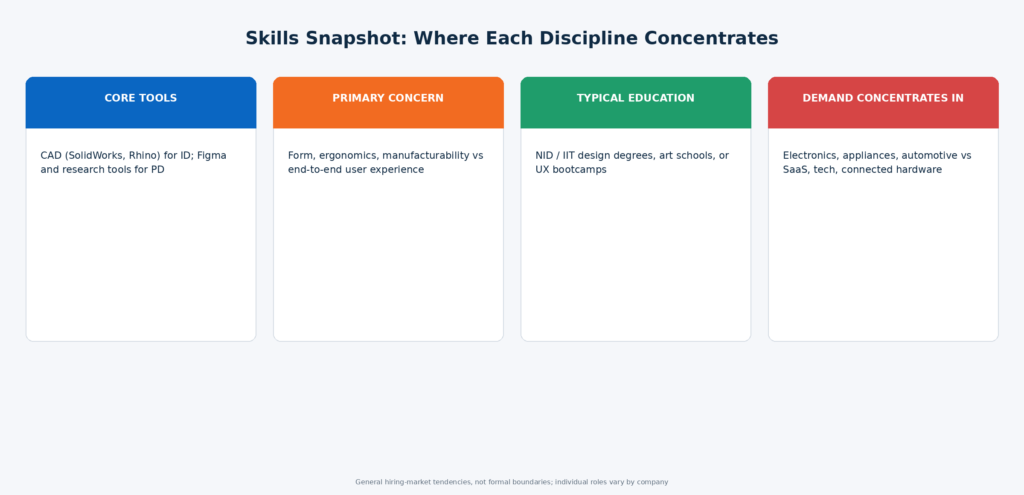
| Factor | Industrial Design | Product Design |
|---|---|---|
| Typical scope | Physical, mass-manufactured objects | Physical and/or digital products, broader UX scope |
| Core tools | CAD (SolidWorks, Rhino), prototyping, material specification | Figma, user research tools, CAD when physical component exists |
| Primary concern | Form, ergonomics, manufacturability | User problem-solving, end-to-end experience |
| Legal/formal recognition | Explicit term in design-patent and IP filings | Common industry title, less formally defined in law |
| Typical education | Industrial/product design degree (NID, IITs, art schools) | Design, HCI, or industrial design degree; many self-taught via UX bootcamps |
| Where demand concentrates | Consumer electronics, appliances, furniture, automotive | Software/SaaS, tech startups, connected hardware |
One-Page Checklist: Which Designer Do You Need?
| Question | If yes | If no |
|---|---|---|
| Does your product have a physical, manufactured component? | Industrial design skills needed | Product design (digital-only) likely sufficient |
| Will it be mass-produced via injection moulding, casting, or similar? | DFM expertise is essential — industrial design | Move on to next question |
| Does the product include an app, dashboard, or digital interface? | Product design (UX/UI) skills also needed | Industrial design alone may suffice |
| Are you still validating the core concept, pre-manufacturing? | Product design (research, prototyping) first | Industrial design refinement can begin |
| Do you need to file for design IP protection in India? | Use “industrial design” terminology with your IP counsel | Terminology is less critical |
Conclusion
Product design and industrial design are related, overlapping, and frequently confused — but they’re not the same thing, and the difference matters most the moment you’re writing a job description, briefing an agency, or filing for design protection. Industrial design stays anchored to physical, manufactured objects and the craft of making them look right, feel right, and produce correctly at scale. Product design has grown into the broader term, covering that same physical work but extending into digital products and the full user journey that industrial design was never built to cover. If you’re building a physical product and need the manufacturability, ergonomics, and form expertise that sits at industrial design’s core, Growthkul’s Product Design team works through exactly this process — from concept to a design that’s actually ready for production, not just a nice render. Whichever term you use to search for help, be specific about whether your product lives in a factory, a phone, or both — that’s the question that actually decides who you need to hire.
