
A TVC is a television commercial — a short, produced video, usually 10 to 60 seconds long, made to run as a paid advertisement during TV broadcast breaks. It’s one of the oldest formats in advertising, and despite the shift of ad budgets toward digital, the TVC remains a distinct, well-defined category with its own production process, broadcast rules, and creative conventions in India.
This article covers what the term actually means, how a TVC is different from an ad film, a brand film, and a DVC, how TVC advertising works within India’s broadcast system, and when a TVC is actually the right format for your brand.
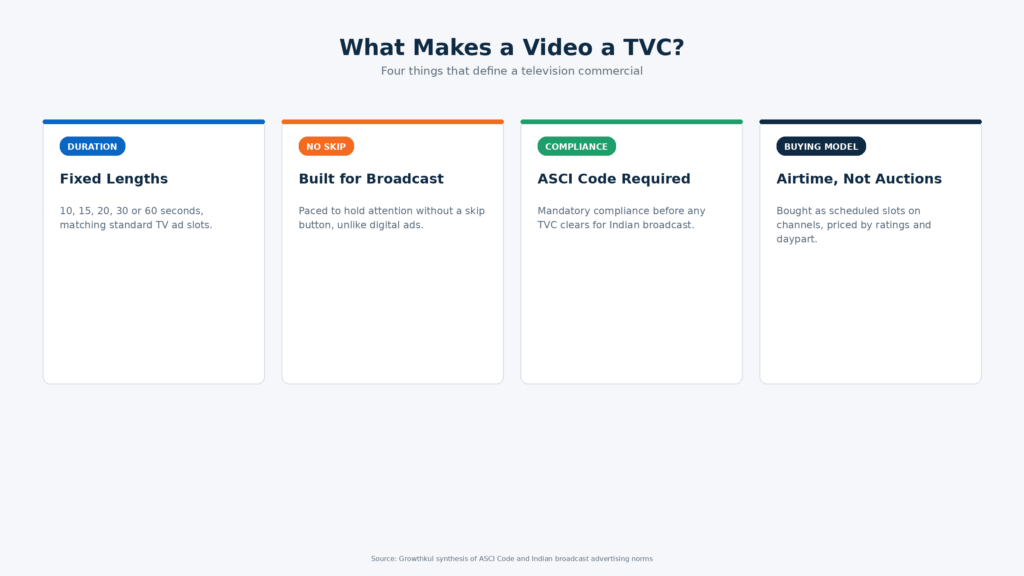
A four-card overview of what defines a television commercial The four things that separate a TVC from any other video ad
TVC Full Form and Meaning
TVC stands for Television Commercial. In marketing and advertising, the term refers to a short-form video advertisement produced specifically for broadcast on television, as opposed to video content made primarily for YouTube, social media, or a website.
A few things define what makes a video a TVC rather than just “a video ad”:
- It’s built for broadcast, not for scroll. A TVC is designed to hold attention for its full duration without a skip button, which shapes how it’s paced and structured compared to digital-first formats.
- It runs in a fixed, standard duration. Common TVC lengths are 10, 15, 20, 30, and 60 seconds, largely because TV ad slots are sold and scheduled in these fixed increments.
- It follows broadcast content norms. In India, TV commercials must comply with the ASCI Code (the Advertising Standards Council of India’s self-regulation code), which has been mandatory for TV advertisements since a 2006 amendment to the Cable Television Networks Rules made ASCI Code compliance a condition for an ad to be carried on cable television.
- It’s typically bought as time on a channel, priced and scheduled around specific programming, dayparts, and audience ratings — a fundamentally different buying mechanism from digital ad placements.
“TVC marketing,” “TVC ads,” and “TVC campaign” all refer to the same underlying idea: using one or more television commercials as part of a broader advertising or brand campaign, usually alongside other formats.
How a TVC Differs from an Ad Film, a Brand Film and a DVC
These four terms get used loosely and interchangeably in casual conversation, but they describe genuinely different things:
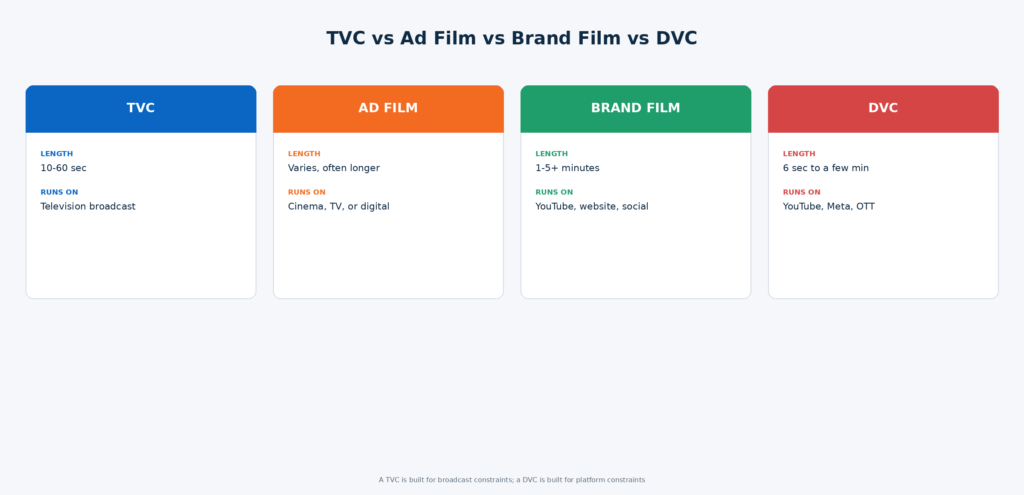
A four-column comparison of TVC, ad film, brand film, and DVC by length and where they run Four terms that get used loosely, but describe genuinely different formats
| Format | What it actually is | Typical length | Where it runs |
|---|---|---|---|
| TVC | A commercial made specifically for TV broadcast, built to broadcast-length and content norms | 10–60 seconds | Television, via paid broadcast slots |
| Ad film | A broader term for any produced advertisement on film — can include TVCs, but also covers cinema ads and longer-format brand advertising | Varies, often longer than a TVC | Cinema, TV, or digital, depending on the cut |
| Brand film | A longer, usually narrative-driven piece focused on brand story and values rather than a direct product pitch or call to action | 1–5 minutes or more | Primarily digital — YouTube, website, social |
| DVC (Digital Video Commercial) | A video ad built specifically for digital platforms, where skip buttons, vertical formats, and sound-off viewing all shape the edit | Highly variable, often shorter for social, 6 seconds to a few minutes | YouTube, Meta, Instagram, OTT platforms |
A note on DVC terminology: usage of “DVC” varies across the industry — some use it strictly for digital-only video ads, while others use it more loosely to mean any video commercial cut for digital distribution, including a re-edited version of a TVC. Confirm the specific definition your team or client is using before relying on it in a brief, since this is one of the more inconsistently applied terms in the space.
The practical difference that matters most: a TVC is built around broadcast constraints — fixed durations, no skip button, ASCI compliance — while a DVC is built around platform constraints — skippability, sound-off autoplay, vertical or square framing, and much shorter attention windows in the first 2-3 seconds.
TVC vs DVC at a Glance
| TVC | DVC | |
|---|---|---|
| Built for | Television broadcast | Digital platforms (YouTube, Meta, OTT) |
| Skippable? | No | Often yes, within the first few seconds |
| Typical length | 10–60 seconds, fixed increments | Highly variable, often shorter |
| Regulatory framework | ASCI Code, mandatory for TV | ASCI Code applies broadly, platform policies also apply |
| Buying model | Airtime slots on channels/programmes | Platform ad auctions, targeting-based |
How TVC Advertising Works in India
TV advertising in India runs on a few interlocking systems that are worth understanding before commissioning a TVC:
Audience measurement. TV ad buying and scheduling decisions are heavily informed by BARC India (Broadcast Audience Research Council), the industry body that measures television viewership through a panel-based system. BARC data on channel and programme viewership is what media planners use to decide which channels and slots a TVC should run in. Note that BARC’s ratings publication has seen periods of regulatory suspension as India’s Television Ratings Policy has been updated, so confirm current ratings availability with your media buying team before finalising a plan.
Content compliance. Every TVC intended for Indian television must comply with the ASCI Code before it’s cleared for broadcast — a requirement tied into the Cable Television Networks Rules, not optional guidance. The code covers truthful claims, decency standards, and specific rules for sensitive categories like health, finance, and children’s advertising. Production houses typically build these checks into the script and storyboard stage, not after filming.
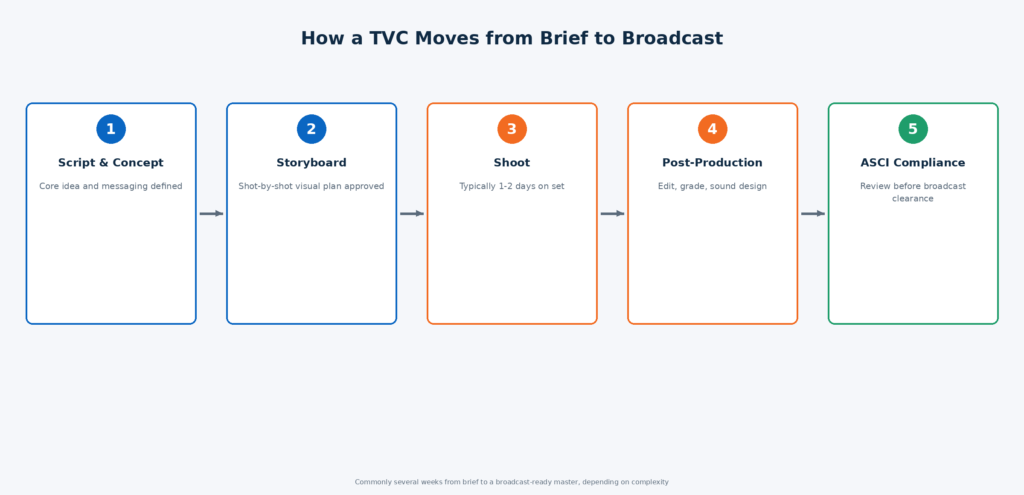
Production and media buying. A typical TVC moves through scripting, storyboarding, a shoot (often 1–2 days), post-production, and a compliance review before the final master is sent to channels — commonly several weeks from brief to broadcast. Once ready, it’s scheduled across channels and slots based on audience habits, ratings, and budget, usually by a media buying agency working from BARC data.
A five-step flow diagram showing how a TVC moves from script to broadcast From script to broadcast-ready master, typically several weeks end to end
What a TVC Is Used For
TVCs are generally the right tool for specific jobs rather than a universal advertising format:
- Mass-reach brand awareness. TV reaches large, broad audiences in a single placement — effective for new product launches, rebranding, or category-defining campaigns.
- Building brand trust and credibility. A TV presence still signals brand scale and legitimacy to many Indian consumers, particularly in FMCG, BFSI, and consumer durables.
- Reinforcing a campaign across formats. Many brands use a TVC as the “hero” asset, then cut shorter DVC versions for digital — getting broadcast reach and digital frequency from one core idea.
- Reaching audiences digital under-serves. Certain demographics and regions in India still over-index on TV viewership relative to digital, making a TVC more efficient than a purely digital plan.
Is a TVC Right for Your Brand?
A TVC tends to make sense when a brand has a large enough target audience and budget to justify broadcast-scale reach, a message suited to a short, high-production-value format, and a reason to prioritise broad awareness over narrow, trackable targeting. It tends to make less sense for very niche audiences, highly performance-driven campaigns where click-level attribution matters most, or budgets too small to produce and air a TVC at a broadcast-ready quality bar — in those cases, a DVC built for digital platforms is usually the more efficient starting point.
Common TVC Terms
A four-column glossary of common TVC terms: spot, daypart, GRP, and master A quick-reference glossary for anyone new to TV advertising terminology
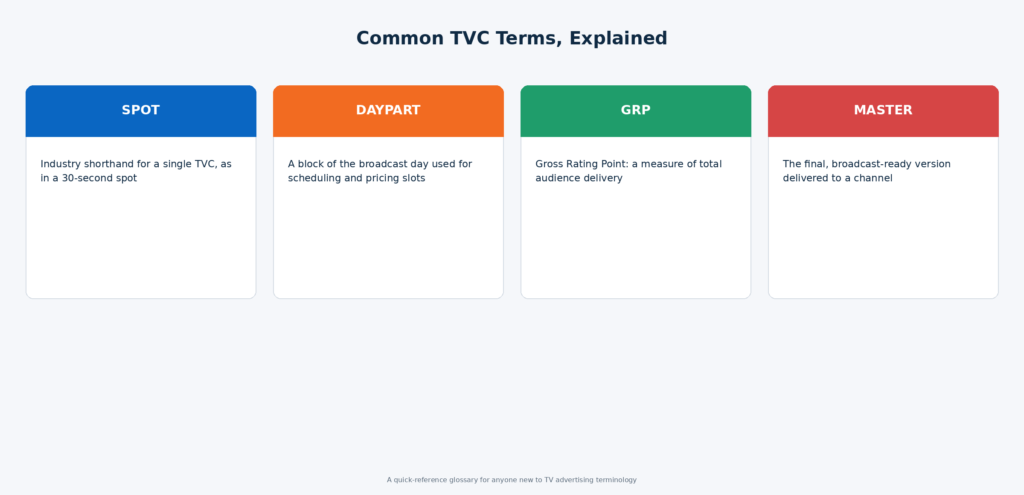
A short glossary for anyone new to the space:
- Spot — industry shorthand for a single TVC, as in “a 30-second spot.”
- Daypart — a block of the broadcast day (morning, prime time, late night) used for scheduling and pricing ad slots.
- GRP (Gross Rating Point) — a measure of a TVC campaign’s total audience delivery, used in media planning.
- Storyboard — the shot-by-shot visual plan approved before a TVC goes into production.
- Master — the final, broadcast-ready version of a TVC, delivered in the technical format a channel requires.
- ASCI clearance — informal shorthand for a TVC having passed the compliance review required before broadcast.
Conclusion
A TVC is simply a television commercial — a short, broadcast-built video ad with its own durations, compliance requirements, and buying process, distinct from a DVC, an ad film, or a brand film even though the terms get used loosely in casual conversation. Whether a TVC is the right starting point for your brand depends on your audience, budget, and whether broad broadcast reach or precise digital targeting matters more for the campaign at hand. If you’re ready to brief a TVC and want a team that handles the full process — concept, shoot, ASCI-compliant post-production, and a broadcast-ready master — Growthkul’s TV commercial production and ad film production services in Delhi NCR team can take your brief from script to screen.
