
If you need video content once or twice a year, a project-based contract is almost always the right call. If you need video content every month — product demos, training content, event coverage, social cutdowns — a retainer typically works out cheaper per video and gets you faster turnarounds, once your volume justifies the fixed monthly commitment. The honest dividing line isn’t quality or trust, it’s volume: retainers reward consistent, predictable output, and project contracts reward occasional, well-defined deliverables.
That’s the short version. The more useful version covers what each model actually includes, what retainers cost at different tiers, a worked cost comparison most agencies won’t walk you through unprompted, and what to watch for specifically if you’re commissioning corporate or industrial video production in India, where production norms and pricing differ from the largely US-centric sources most comparisons draw from.
What a Video Production Retainer Actually Is
A video production retainer is a recurring monthly agreement where a production company commits a set amount of capacity — shoot days, editing hours, a defined number of finished videos — in exchange for a fixed fee, rather than negotiating and quoting each video separately. A typical retainer package bundles pre-production planning, filming, post-production, motion graphics, and an agreed number of revision rounds per asset, with deliverables defined upfront rather than scoped fresh each time.
Retainer pricing tends to fall into fairly consistent tiers across the industry, based on commonly published agency rate cards:
| Tier | Typical monthly fee | What it usually includes |
|---|---|---|
| Starter | $4,000–$6,000 (~₹3.3–5 lakh) | 1–2 videos/month, basic editing, limited motion graphics |
| Mid-tier | $7,000–$12,000 (~₹5.8–10 lakh) | 3–5 videos/month, dedicated editor, standard motion graphics |
| Enterprise | $15,000–$20,000+ (~₹12.5–16.6 lakh+) | Multi-region or dedicated creative team, bi-weekly strategy sessions, priority turnaround |
These bands come from published pricing guidance at video production agencies and should be treated as a rough market reference, not a quote — actual retainer pricing varies by scope, region, and the production company’s overhead.
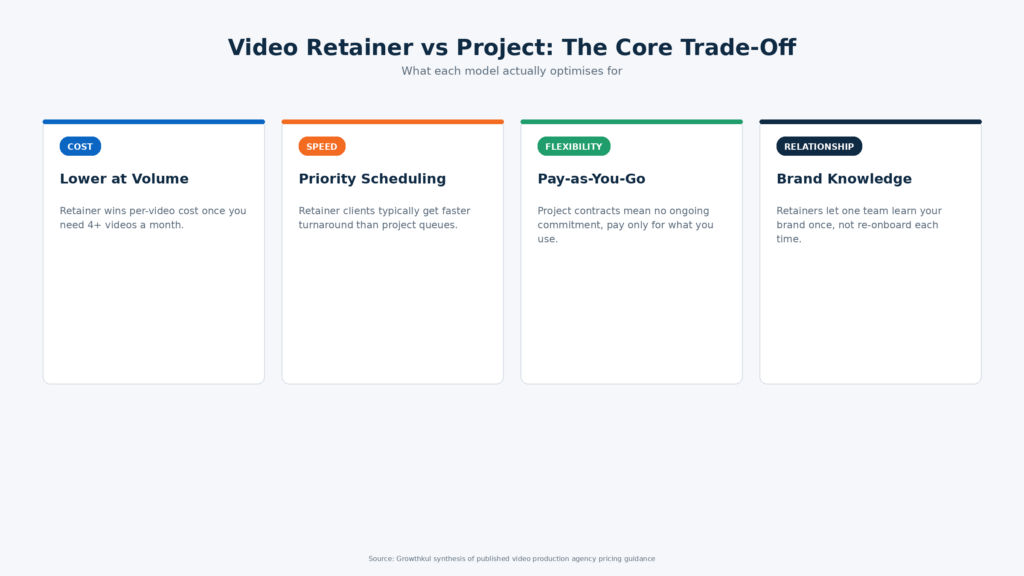
The core trade a retainer makes is: you commit to paying every month whether or not you use the full allocation, and in exchange you get priority scheduling, a lower blended rate per video, and a team that already knows your brand, so each new video skips the onboarding and discovery work a one-off project requires.
Most retainer agreements are structured around one of two commitments: a fixed number of finished videos per month, or a fixed number of production hours or shoot days that get allocated across however many pieces of content fit within that time. The first structure is easier to budget against and is more common for businesses with a predictable content calendar — a set number of social cutdowns, training modules, or product updates each month. The second suits businesses whose content needs vary in complexity month to month — one month might need a single, heavily produced brand film; the next might need five lightweight social clips — where a fixed video count would either overcommit or undercommit the production team’s time.
A four-card comparison of retainer and project-based video production across cost, speed, flexibility, and relationship The core trade-off most agencies don’t spell out upfront
What Project-Based Video Production Actually Is
Project-based video production is a scoped, one-time engagement: a defined deliverable, a fixed timeline, and a total budget agreed before work starts. Each new project runs through its own cycle — initial consultation, proposal, scope approval, production, delivery — independent of any other project, even if it’s the same client coming back six months later.
Per-project pricing for a single corporate video commonly runs anywhere from $10,000 to $50,000 depending on complexity, shoot days, locations, and post-production demands, with larger brand films going well beyond that range. In the Indian market, a single well-produced corporate or industrial video — one shoot day, professional crew, standard post-production — typically lands in the ₹1.5–6 lakh range, with multi-location industrial documentation projects (plant walkthroughs, manufacturing process films) often running higher due to travel, permissions, and extended shoot days.
Project-based work’s core advantage is also its core limitation: every project is self-contained, so you only pay for what you use, with no ongoing commitment — but that also means every project pays its own onboarding and discovery cost, which a retainer spreads across months instead.
That onboarding cycle is often underestimated when comparing the two models on price alone. A new production partner typically needs time to understand your brand guidelines, product details, compliance requirements, and internal approval process before a single frame is shot — and that discovery work gets billed, implicitly or explicitly, into every new project’s cost and timeline. A business that commissions four separate projects across a year with four different vendors pays that onboarding tax four times over; the same business working with one vendor across four projects pays it once, even without a formal retainer in place, simply by maintaining continuity with one team.
A Worked Cost Comparison: Three Videos, Two Ways
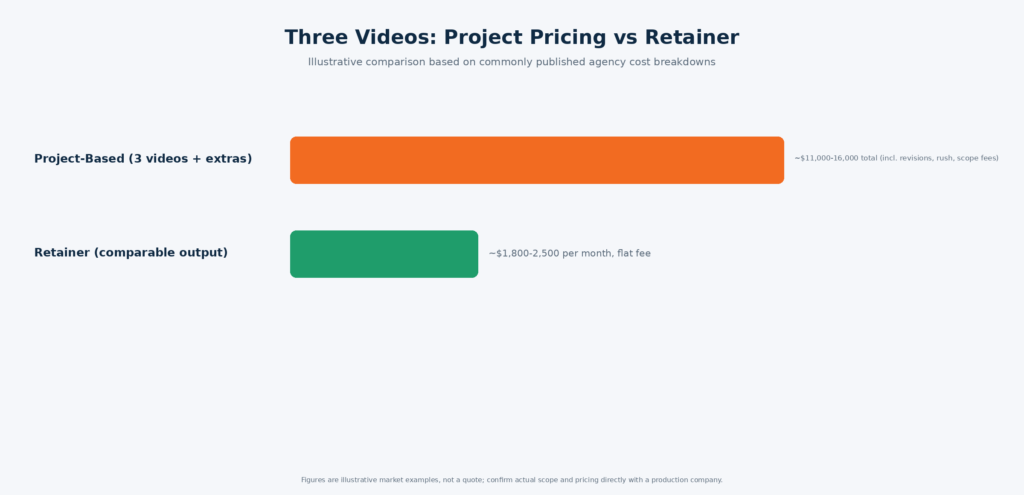
Published cost breakdowns from video production companies offer a useful illustration here. One commonly cited comparison: three videos produced individually at roughly $3,500–4,500 each, plus typical add-ons — revision rounds, rush delivery, scope changes — can total somewhere around $11,000–16,000 once those extras are included. The same volume of output under a retainer arrangement, by contrast, is often quoted as a flat monthly fee in the $1,800–2,500 range covering a comparable 3–5 finished projects.
The gap isn’t purely vendor-side efficiency — it also reflects what project pricing has to cover that a retainer amortises: a fresh discovery call, a new creative brief, and a new onboarding cycle for every single project, versus one onboarding cycle covering months of output under a retainer.
This is illustrative of commonly published industry comparisons, not a guarantee of your specific costs — actual savings depend heavily on your real video volume, complexity, and the specific production company’s rate structure. Businesses producing four or more videos a month are frequently cited as the volume threshold where retainer savings of roughly 15–25% per video, compared to per-project pricing, become reliable rather than occasional.
A horizontal bar chart comparing typical three-video cost under project-based pricing versus a comparable retainer Where the retainer discount typically comes from, not just agency margin
A Decision Table: Which Model Actually Fits Your Situation
| Your situation | First thing to check | Likely right choice |
|---|---|---|
| One major launch video, no other video planned this year | Is there any follow-up video need in the next 6 months? | Project-based |
| Monthly product updates, training content, or social cutdowns | Do you need 3+ videos a month, consistently? | Retainer |
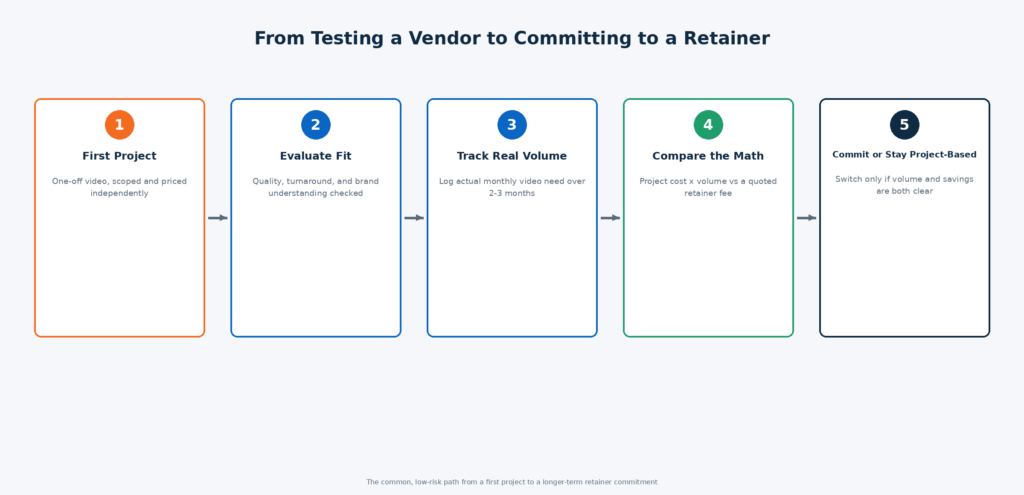
| Testing a new production partner before committing | Have you worked with this team before? | Project-based, then reassess |
| Plant walkthroughs, safety training, or compliance documentation on a fixed annual cycle | Is the need recurring but infrequent (quarterly, not monthly)? | Project-based, revisited each cycle |
| Ongoing corporate content calendar (LinkedIn, YouTube, internal comms) | Is there a content calendar that needs consistent output? | Retainer |
| Needs change drastically month to month, hard to predict scope | Can you define deliverables 4–8 weeks ahead? | Project-based — retainers need predictable scope to work |
| Spending ₹8 lakh+ a year on video through repeated one-off contracts | Would consolidating into one team change quality or cost? | Worth quoting a retainer for comparison |
This table reflects general industry guidance, not a formula — a hybrid of both models, used for different categories of video, is common and often the most practical real-world setup.
When Project-Based Makes More Sense
Project contracts are the better default in several recurring situations:
- You need video once or twice a year. A retainer’s fixed monthly cost only pays off against volume you don’t have yet.
- You’re testing a new production partner. Commit to one project before locking into a monthly relationship you can’t easily unwind.
- Your needs change too unpredictably for fixed scope. Retainers work best when you can define deliverables several weeks ahead; if scope genuinely shifts month to month, a fixed retainer allocation gets wasted or constantly renegotiated.
- The project has a hard, singular endpoint. A plant inauguration film, a one-time investor video, a single trade-show reel — these don’t benefit from an ongoing relationship structure.
- You want to protect budget and limit vendor commitments. Some organisations deliberately prefer project-based engagements specifically to retain flexibility and avoid being locked into one creative partner.
When a Retainer Makes More Sense
The reverse list matters just as much, particularly for organisations with a genuine content cadence:
- You need 3+ videos a month, consistently, for 6+ months. This is the volume threshold most commonly cited for retainer savings to become reliable rather than occasional.
- Speed and priority access matter. Retainer clients typically get faster turnarounds and priority scheduling over project-based clients competing for the same production slots.
- You’re spending significant annual budget through repeated one-off contracts anyway. If you’re already commissioning video every month through separate projects, you’re likely already paying the onboarding and discovery overhead a retainer would eliminate — without getting the lower blended rate in return.
- You want a team that learns your brand once and keeps applying that knowledge. Industry commentary on agency relationships broadly agrees that continuity compounds: a team that already understands your brand, products, and compliance requirements works faster and makes fewer mistakes than one starting fresh on every engagement.
- You need consistent output for an ongoing content calendar — LinkedIn thought-leadership clips, YouTube training series, recurring internal communications — where gaps in cadence actually hurt the strategy.
A flow diagram showing how to move from project-based testing to a retainer once volume justifies it The common path from testing a vendor to committing to a retainer
A Myth Worth Correcting: “Retainers Are Always Cheaper”
A claim that circulates often in agency marketing is that retainers are simply, unconditionally cheaper than project work — framed as an easy, low-risk sell. This isn’t quite accurate, and treating it as a blanket rule can cost you money. The retainer discount is real, but it’s volume-dependent: agencies and video production companies consistently frame the saving as kicking in specifically above a certain output threshold, commonly cited as four or more videos a month, not as a universal discount that applies regardless of how much content you actually need.
Below that threshold, a retainer can easily cost more than the project-based equivalent, because you’re paying for capacity you aren’t using. The more defensible framing, consistent with how production companies themselves describe it: retainers save money when volume is high and predictable; below that volume, or when needs are unpredictable, project-based pricing is usually the cheaper and more flexible option. Neither model is categorically better — the right one depends entirely on your actual, honest video cadence, not on which one a sales pitch happens to favour.
There’s a second, subtler version of this myth worth naming: the assumption that a lower headline monthly number automatically beats a higher per-project quote, without checking what’s actually included. A $1,800 monthly retainer quoted against a $3,500 per-video project rate looks like an obvious win on paper, but if the retainer’s monthly video count, revision allowance, or turnaround commitment is thinner than what the project quote included, the comparison isn’t actually apples to apples. Always compare scope line by line — videos per month, revisions included, shoot days covered, turnaround time — rather than comparing the two headline numbers alone.
The Hidden Costs Nobody Mentions Upfront
Cost comparisons that only look at the headline monthly fee or per-project quote routinely miss the line items that actually determine whether a contract was good value in hindsight. A few costs tend to surface only after a contract is signed, under both models, and are worth asking about directly before committing:
- Revision rounds beyond what’s included. Both retainers and project contracts typically cap included revisions — extra rounds get billed separately, and this is a common source of project-based cost overruns specifically.
- Rush delivery fees. Under project pricing, compressing a timeline often triggers a rush surcharge; under a retainer, this is sometimes — but not always — absorbed within the monthly fee, so confirm explicitly.
- Scope change fees. A brief that shifts mid-project (new messaging, additional stakeholders, a changed CTA) commonly triggers change fees under project contracts; retainers handle this more gracefully if the change fits within the existing monthly allocation, but not if it exceeds it.
- Unused retainer capacity. Most retainer agreements don’t roll over unused shoot days or editing hours month to month — confirm this explicitly, since it directly affects whether the retainer math actually works out in your favour.
- Travel and location costs. For industrial and plant-based shoots specifically, travel, permissions, and multi-day location costs are frequently billed separately from the core production fee under both models — this is a particularly common blind spot for manufacturing and industrial clients budgeting for a retainer.
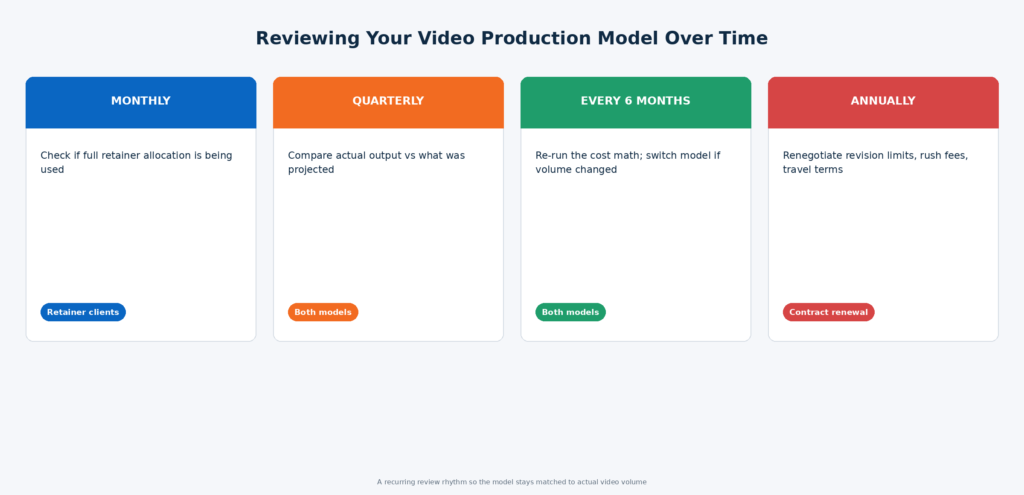
Cadence Checklist: Reviewing Your Video Production Model
| Cadence | What to check | Which model benefits |
|---|---|---|
| Monthly | Are you using the full retainer allocation, or paying for unused capacity? | Retainer clients specifically |
| Quarterly | Has your actual video output matched what you projected when choosing the model? | Both — reassess fit |
| Every 6 months | Would switching models (project → retainer, or vice versa) save money at your current volume? | Both |
| Annually | Should revision-round limits, rush-fee terms, or travel-cost clauses be renegotiated? | Both — contract renewal point |
| Per major initiative (product launch, plant opening) | Does this one-off need exceed your retainer’s monthly scope, requiring a separate project add-on? | Retainer clients, occasionally |
India-Specific Notes
A few points worth flagging specifically for Indian businesses, especially those commissioning corporate or industrial video production, since pricing norms and production practices here differ from the largely US-centric sources most comparison articles are built on:
- Corporate and industrial video pricing in India sits well below US benchmarks in absolute terms, but the volume threshold where retainers pay off tends to track similarly in proportion — businesses producing 3–4+ videos a month are typically where the retainer math starts favouring the fixed monthly model over repeated one-off quotes.
- Industrial and manufacturing video work — plant walkthroughs, safety training, process documentation, compliance videos — often follows a predictable but infrequent cadence (quarterly or tied to specific compliance cycles) rather than a true monthly rhythm, which more often favours project-based contracts, even for large manufacturers, unless there’s a genuinely ongoing content need (training libraries, recurring internal comms) layered on top.
- GST and invoicing structure differ between the two models. A retainer is typically invoiced as a recurring monthly service fee, while project-based work is invoiced per milestone or on delivery — this affects how the engagement shows up in your accounting and budgeting cycles, and is worth clarifying with your finance team before choosing a model purely on production merits.
- Delhi NCR’s corporate and industrial video production market includes both specialist industrial-documentation studios and broader corporate-content agencies; if your need spans both categories (a plant walkthrough and an ongoing LinkedIn content calendar, for instance), it’s worth asking a single provider whether they can structure a hybrid arrangement — project pricing for the industrial documentation work, a lighter retainer for the recurring corporate content — rather than assuming one model has to cover everything.
One-Page Summary: Retainer vs Project
| Factor | Retainer | Project-Based |
|---|---|---|
| Best for | 3+ videos/month, consistent cadence | Occasional or one-off video needs |
| Typical cost structure | Fixed monthly fee | Fixed fee per project, scoped upfront |
| Per-video cost at volume | Lower (15–25% savings commonly cited above 4 videos/month) | Higher per video, but no ongoing commitment |
| Onboarding overhead | Paid once, amortised across months | Paid fresh on every project |
| Turnaround speed | Typically faster, priority scheduling | Standard scheduling, queued against other clients |
| Flexibility | Lower — fixed monthly commitment | Higher — pay only for what you use |
| Best suited to | Ongoing content calendars, recurring training/comms | Launches, one-off compliance films, testing a new vendor |
A four-column cadence checklist for reviewing whether your current video production model still fits A recurring rhythm for checking the model is still the right fit as your needs change
Conclusion
The choice between a video production retainer and project-based contracts isn’t about which model is inherently better — it’s about matching the commercial structure to your actual, honest video cadence. If you need video consistently, every month, a retainer typically lowers your per-video cost and gets you faster turnarounds once a team already knows your brand. If your need is occasional, a one-off launch, or a compliance-driven industrial documentation project on an infrequent cycle, project-based pricing keeps you paying only for what you actually use. If you’re weighing this decision for corporate or industrial video work specifically, Growthkul’s video production company in Delhi NCR for corporate and industrial team can scope either model — or a hybrid of both — based on your real content calendar rather than a one-size-fits-all package. Whichever you choose first, revisit the decision every few months: the right model today isn’t necessarily the right one once your volume changes.
