
A video production brief is the single document that decides whether your project runs smoothly or burns through three rounds of confused revisions. At minimum, it needs to cover the business objective, the target audience, where the video will be distributed, the budget range, the timeline, the tone and style, and any reference material — leave any one of these out, and the agency ends up guessing, which almost always costs you time and money later.
This article is a working checklist, not a lecture on creative philosophy: what a brief must include, a worked example showing the real-world cost of skipping sections, why hiding your budget backfires more often than it protects you, and what to do if a brief goes sideways mid-project. It also covers what changes specifically if you’re briefing a corporate or industrial video production agency in India.
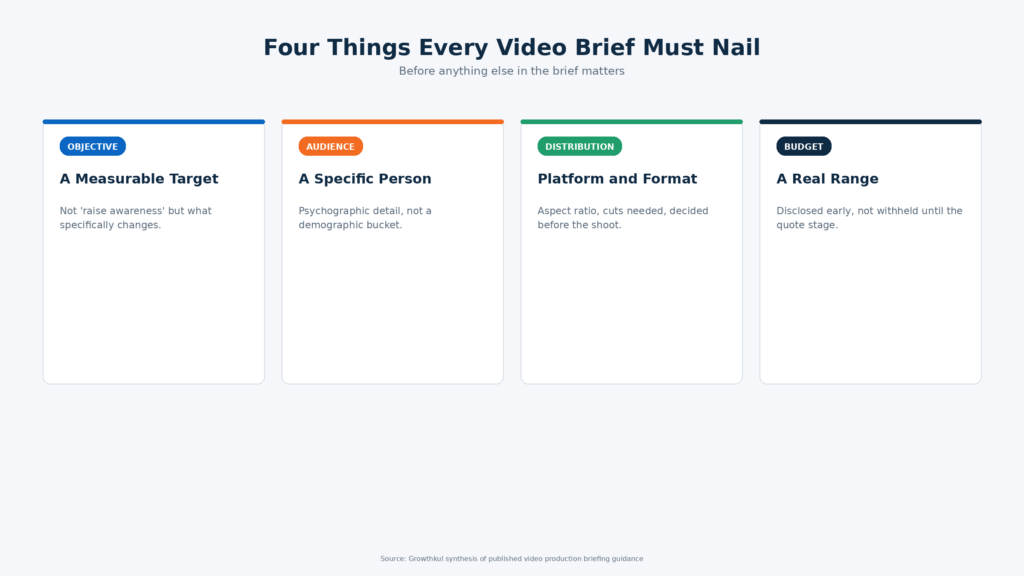
A four-card overview of the four things every video production brief must nail Objective, audience, distribution, and budget — the four pillars everything else builds on
What a Video Production Brief Actually Needs to Do
A brief’s job is to give a production team, who weren’t in the room when your business decided it needed a video, enough shared context to make the same creative decisions you would make yourself. Industry guidance consistently frames this as the brief’s core function: it is the written document that tells a production team what to make, who it is for, where it will run, and what it has to accomplish — and, critically, it is not a script. A brief that arrives already fully scripted and storyboarded has quietly shifted the creative risk back onto you while still paying the agency for execution only, which usually produces a worse result than letting the agency’s own expertise shape the how.
The brief’s real value compounds downstream. Teams that skip this step consistently report the same failure pattern: a marketing team wants something “fun and casual,” the agency delivers something cinematic and serious, and the gap only surfaces after a full cut has already been produced — at which point fixing it costs a full round of revisions rather than a five-minute conversation upfront.
It’s also worth being clear about who the brief is actually for. A brief written only for the production agency often misses the fact that it will also be read, interpreted, and occasionally second-guessed by multiple people on your own side — a marketing director, a business unit head, sometimes a legal or compliance reviewer. A brief that’s clear enough for an outside agency to execute confidently is usually also clear enough to prevent internal disagreement from surfacing for the first time only after the agency has already started work. Writing the brief is, in a real sense, the moment your own organisation is forced to agree on what it actually wants — which is precisely why skipping it or rushing it tends to surface problems later rather than avoiding them.
The Core Checklist: What Every Brief Must Include
Strip away the formatting differences between templates — and there are dozens of slightly different brief formats published by different agencies, each with their own section headers and ordering — and nearly every credible source converges on the same core components, just arranged differently:
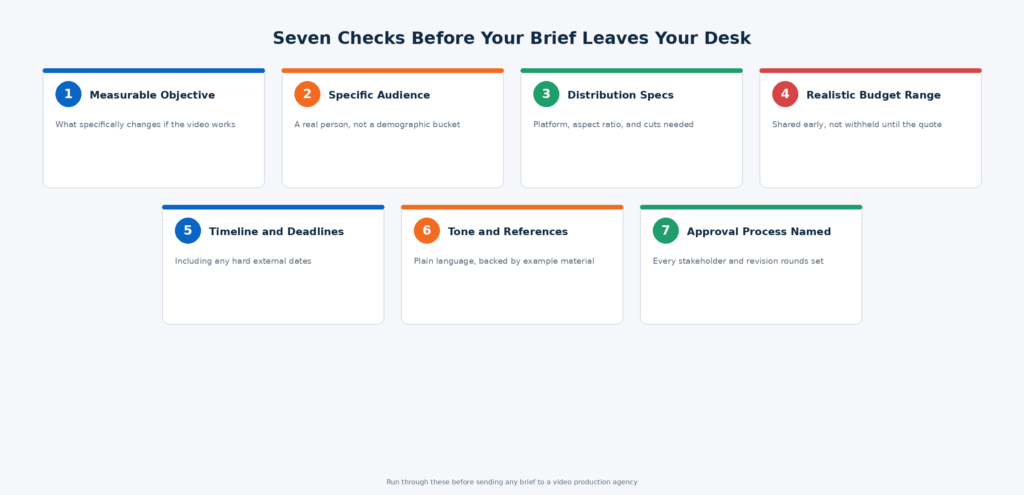
- Business objective, stated with a measurable target. Not “increase brand awareness” but what specifically changes if the video works — leads, sign-ups, a measurable shift in a tracked metric.
- Audience profile, with enough psychographic detail to write for a specific person, not a demographic bucket. “CFOs at mid-market logistics firms” gives a team something to aim at; “business professionals” doesn’t.
- Distribution and format specs, decided upfront: platform (YouTube, LinkedIn, a landing page, an internal training portal), aspect ratio (16:9, 9:16, 1:1, 4:5), and any additional cuts needed (captioned versions, music-free versions, clean footage without text overlays for later repurposing).
- Budget range, not a maximum kept secret until the quote stage. A production company that knows the real number can tell you immediately what’s achievable and which trade-offs apply — treating budget disclosure as a negotiating weakness almost always backfires, which the next section covers in more depth.
- Timeline and key deadlines, including any hard external dates (a launch date, an event, a campaign start) the video absolutely must hit.
- Tone and style direction, described in plain language and, ideally, backed by reference material — a competitor’s video you admire, your own brand guidelines, or prior videos that got the tone right or wrong.
- Key message, kept to one sentence. If you can’t compress what the video needs to say into one sentence, that’s a sign the strategy work isn’t finished yet, not that the brief needs to be longer.
- Logistics, covering who approves each stage, how many revision rounds are included, and who the single point of contact is on your side.
A Worked Example: Weak Brief vs Strong Brief
The difference between a vague brief and a specific one isn’t stylistic — it changes what gets produced. Industry guidance offers a concrete illustration of exactly this gap:
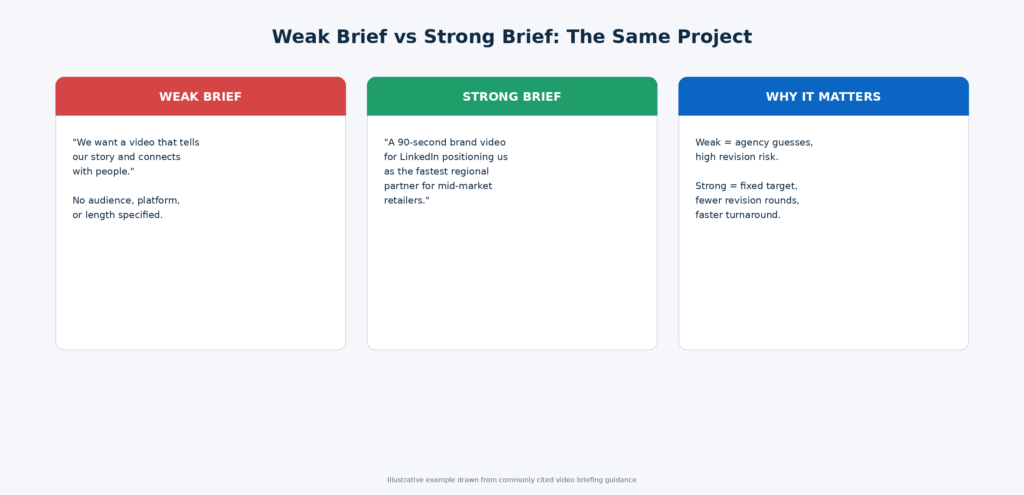
Weak: “We want a video that tells our story and connects with people.” Strong: “We need a 90-second brand video for LinkedIn that positions our Miami-based logistics firm as the fastest and most reliable regional partner for mid-market retailers.”
The weak version gives a production team almost nothing to anchor creative decisions to — length, platform, audience, and positioning are all left to guesswork, and whatever the agency produces will be, at best, a reasonable guess at what you meant. The strong version fixes length, platform, audience, and core positioning in one sentence, which means every subsequent creative decision — pacing, visual style, voiceover tone — has a fixed target to be judged against.
| Element | Weak brief | Strong brief |
|---|---|---|
| Objective | “Tell our story” | “Position as the fastest, most reliable regional partner for mid-market retailers” |
| Audience | Unstated | Mid-market retail logistics buyers |
| Platform/format | Unstated | LinkedIn, 90 seconds |
| Likely outcome | Agency guesses; high revision risk | Agency has a fixed target; fewer revision rounds |
This isn’t a hypothetical difference in style — it’s the difference between a brief an agency can execute confidently and one that forces them to produce multiple exploratory directions before you can even react to one.
A three-column comparison of a weak brief, a strong brief, and why the gap actually matters The same project, two briefs, two very different starting points for the agency
The Real Cost of a Missing Brief: Revision Cycles and Timeline
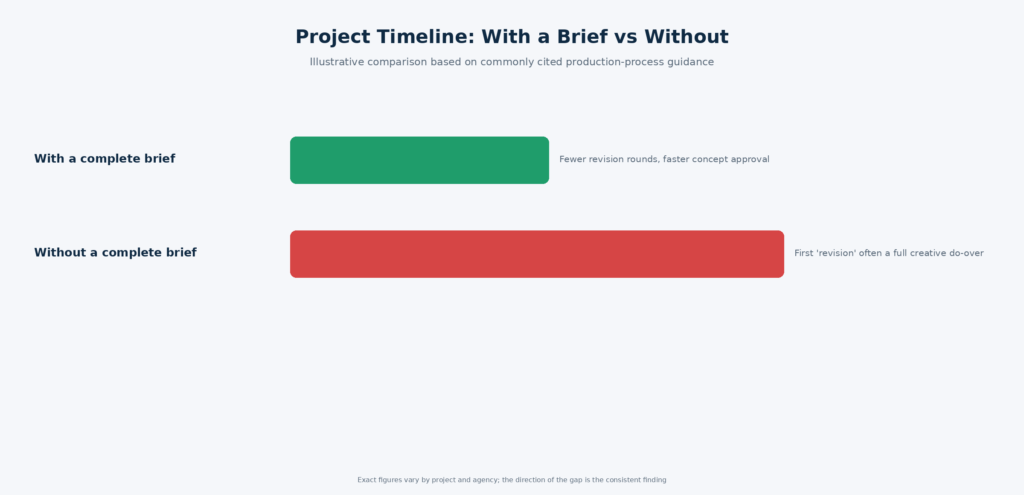
Published production-process guidance frequently includes a direct comparison of project timelines with and without a complete brief in place, and the pattern is consistent: projects that start with a clear, complete brief move through concept and revision stages measurably faster than projects where the production team has to extract missing information mid-process. The exact numbers vary by source and project type, but the mechanism is the same in every case — every piece of information missing from the brief has to be gathered eventually, and gathering it after a first cut exists is slower and more expensive than gathering it before anyone has touched a camera or a timeline.
This matters most in the revision-round economics specifically. Most production contracts include a fixed number of included revision rounds; when a weak brief forces the team to guess at tone, audience, or key message, the first “revision” often isn’t a small tweak — it’s effectively a full do-over of the creative direction, which can burn through your entire included revision allowance on a single round.
A horizontal bar comparison showing how project timelines and revision cycles typically differ with a complete brief versus a missing one Where the real cost of a missing brief actually shows up
A Myth Worth Correcting: “Hiding Your Budget Protects You”
A belief that circulates often among first-time clients is that withholding your budget range until the quote stage protects you from being overcharged — the logic being that if the agency doesn’t know your ceiling, they can’t price up to it. This is largely backwards in practice. Production-industry guidance is consistent on this point: being coy about budget is counterproductive — it just wastes time with proposals that don’t fit your constraints, and a production company that knows your real number can immediately tell you whether your goals are achievable within it and what trade-offs would apply, rather than presenting a scope built for a budget you were never going to approve.
The more defensible framing: disclosing a realistic budget range early doesn’t invite inflated pricing from a reputable agency — it lets them scope the right level of production value (crew size, shoot days, post-production depth) for what you’re actually willing to spend, which produces a proposal you can say yes to on the first pass rather than a negotiation that starts from an unworkable number.
Platform and Format Specs: A Checklist You Shouldn’t Skip
Where a video will actually be watched changes nearly every production decision that follows, and this is one of the most commonly under-specified sections in real briefs:
| Platform | Typical aspect ratio | Format notes |
|---|---|---|
| YouTube / website | 16:9 | Longer-form content tolerated; sound-on viewing more common |
| LinkedIn feed | 1:1 or 4:5 | Often needs captions; many viewers watch sound-off |
| Instagram/LinkedIn Stories | 9:16 | Vertical, short attention window, front-loaded message |
| Internal training/onboarding | 16:9, usually | Longer tolerance, but needs clear chaptering/navigation |
| Trade show loop | 16:9 or custom | No audio reliance; must work as a silent, looping visual |
Specifying these upfront — rather than requesting reformats after the first edit is locked — is one of the simplest, highest-leverage things a brief can do to avoid avoidable rework. If you need multiple cuts for multiple platforms from one shoot, say so in the brief itself, since it changes how the shoot is planned, not just how the edit is finished.
The Brief vs the Script: Don’t Confuse the Two
A common point of confusion, especially for teams briefing a video agency for the first time, is whether they’re expected to supply a script. They’re not, and trying to can actually hurt the project. A brief tells the team what to make, who it’s for, and what it has to accomplish; a script is a specific execution of that brief, and a good production company will typically write the script for you, informed by your brief, because they understand what works in video format better than most internal marketing teams do. Arriving with a brief that’s already been scripted, shot-listed, and storyboarded removes the agency’s ability to apply their own expertise to the how, while you still pay for their execution time — often producing a flatter result than if you’d let them interpret a well-specified brief themselves.
| Video Production Brief | Script | |
|---|---|---|
| Written by | Client, usually with stakeholder input | Typically the production team, informed by the brief |
| Covers | Objective, audience, distribution, budget, tone | Exact dialogue, scene-by-scene structure, shot direction |
| Locks in | The constraints and goals | The specific creative execution |
| Who should write it | You | Usually the agency, unless you have in-house script expertise |
This distinction matters most when a client arrives with a fully-written script and expects the agency to simply film it. That’s a legitimate way to work if you genuinely have in-house creative expertise and simply need production capacity — but if the goal was to benefit from the agency’s creative judgement, a brief that leaves room for their interpretation of tone, pacing, and visual storytelling will almost always get more out of the relationship than a brief that’s already made every creative decision for them.
A Recovery Plan: If the Brief Goes Sideways Mid-Project
Even a reasonably strong brief can reveal gaps once production is underway. If you’re mid-project and realise direction has drifted:
- Stop before the next production stage begins. Catching a misalignment before the next shoot day or edit pass is far cheaper than catching it after.
- Get the one-sentence key message back on the table. If stakeholders can’t agree on it now, that’s the actual problem — not the footage that’s already been shot.
- Identify exactly which brief section was missing or ambiguous. Was it audience, tone, or distribution format? Naming the specific gap prevents the same mistake on the next project.
- Loop in every internal stakeholder before sending a revision request, not after — a revision based on one person’s note that gets overridden by another stakeholder a week later wastes a full round.
- Ask the agency for their read on the gap, not just a fix. They’ve likely seen this exact failure mode before and can usually pinpoint where the brief under-specified something faster than an internal post-mortem would.
- Update the written brief itself, not just the verbal instructions going forward. An unwritten correction has a way of getting lost by the next review cycle.
- Treat the corrected brief as the new baseline for remaining revision rounds, so everyone is being held to the same standard going forward.
India-Specific Notes
A few things are worth flagging specifically for teams briefing a video production agency in India, since typical client-side habits and production norms here differ somewhat from the largely US/UK-centric sources most briefing guidance is written for:
- Multi-stakeholder sign-off is the norm, not the exception, for corporate and industrial video projects in India, often involving marketing, a business unit head, and sometimes a compliance or legal reviewer for regulated industries. Naming every required approver in the brief itself — not discovering a missing approver mid-revision — is one of the single highest-leverage additions an Indian corporate brief can make.
- Industrial and manufacturing video briefs (plant walkthroughs, safety training, process documentation) commonly need a site-access and safety-clearance section that a generic marketing-video brief template won’t include — who grants plant access, what PPE or safety induction the crew needs, and whether any process footage is commercially sensitive and needs an NDA before the shoot.
- Budget conversations in India are often more indirect than Western briefing guidance assumes. Many Indian procurement processes default to collecting multiple quotes before any budget figure is shared — but the same logic above still applies: giving even a realistic range, rather than none, meaningfully improves the quality and relevance of the proposals you get back, compared to no figure at all.
- Regional language and dubbing needs are frequently an afterthought in briefs for pan-India campaigns, when they actually belong in the original brief — confirming whether a video needs Hindi, regional-language dubbing, or subtitled versions from the outset changes how the shoot is planned (clean audio separation, on-screen text placement) far more cheaply than retrofitting it after a final cut is locked.
One-Page Checklist: Before You Send Your Brief
| Section | Included? |
|---|---|
| Business objective with a measurable target | ☐ |
| Audience profile with real specificity, not a demographic bucket | ☐ |
| Platform and format specs (aspect ratio, cuts needed) | ☐ |
| Realistic budget range, not withheld until the quote stage | ☐ |
| Timeline, including any hard external deadlines | ☐ |
| Tone and style direction, with reference material if possible | ☐ |
| One-sentence key message | ☐ |
| Approval process and single point of contact named | ☐ |
| (India-specific) All required internal approvers named | ☐ |
| (India-specific) Site access/safety clearance, if industrial | ☐ |
A seven-step grid summarising the full checklist a brief needs before it’s sent to an agency Run through these before a brief leaves your desk
Conclusion
A strong video production brief isn’t about writing more — it’s about making sure the objective, audience, distribution specs, budget, timeline, and approval process are all on the page before the agency starts guessing at any of them. The gap between a vague brief and a specific one isn’t stylistic; it’s the difference between a project that moves through production with minor adjustments and one that burns through its entire revision allowance correcting a misunderstanding that a single sentence could have prevented. If you’re about to brief a project and want a team that will ask the right follow-up questions rather than start producing on an incomplete brief, Growthkul’s video production company in Delhi NCR for corporate and industrial team works from exactly this kind of checklist on every project. Whichever agency you brief, run through the checklist above before you hit send — it’s the cheapest step in the entire production process, and the one most likely to save you a full revision round later.
